This week, the Transportation Security Administration (TSA) announced it has ordered $1.3 billion worth of Computed Tomography (CT) scanners to be deployed at airport security checkpoints across the U.S. in a move that should be lauded by travelers.
While the "sophisticated technology" is aimed at making it easier for screeners to spot potential threats, TSA Administrator David Pekoske said that "deploying these units across our security checkpoints as expeditiously as possible will also improve checkpoint efficiency and the passenger experience."
We can only hope.
This latest investment comes on the heels of a $781.2 million purchase last year. If nothing else, these orders show that the TSA isn't content to continue doing airport security the same way.
While everyone is for enhanced safety, spending less time at the checkpoint is what travelers ultimately want seeing as this current way of air travel has only been the norm for a little over two decades.
Few travel experiences are as anxiety-inducing as stepping into a security line, where even TSA PreCheck members can be subject to a random pat-down or bag search. The hope is that with this new technology that won't be necessary.
"The CT scanners apply algorithms to create 3-D rotatable images that help TSA agents detect explosives and prohibited items," writes TravelPulse's Donald Wood. "Officers can view and rotate the photos to analyze and identify threatening items in a passenger’s carry-on baggage."
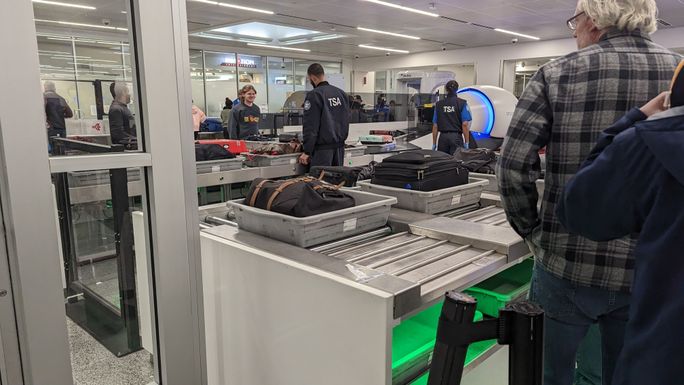
Travelers place items in bins at TSA security line (photo by Eric Bowman)
Fewer delays in both the standard and expedited lines will lead to far less stress among travelers, some of whom may already be worried about reaching their gate in time. Fewer headaches at security could even mean fewer passenger meltdowns in the terminal and in the sky.
In my experience, there are many times when first-time travelers or those who rarely fly are caught off guard by agents' instructions, which aren't always communicated in the kindest tone. That only compounds the stress of air travel.
If removing jackets, shoes, belts, laptops, tablets and liquids is to remain the norm for non-known travelers (TSA PreCheck, Clear, Global Entry, etc.), then speeding up the process by requiring agents to open up and poke through fewer bags can hopefully allow them an extra second or two to exercise more patience if nothing else.
It's important to remember that air travelers never asked for a complicated security checkpoint process or one that makes travel feel more stressful than safe at times.
For the latest travel news, updates and deals, subscribe to the daily TravelPulse newsletter.
Topics From This Article to Explore


