Tourism performance in the U.S. Virgin Islands was looking
especially rosy at the start of 2026, with first-quarter results exceeding both
2025 and the destination’s record-breaking 2024 performance.
Then, on May 2, Spirit Airlines shut down, eliminating more
than a dozen weekly flights to St. Thomas.
That change alone has forced the destination to recalculate
its outlook, according to Alani Henneman, assistant commissioner of marketing
and communications at the U.S. Virgin
Islands Department of Tourism.
“The Spirit issue has changed our projection,” she told
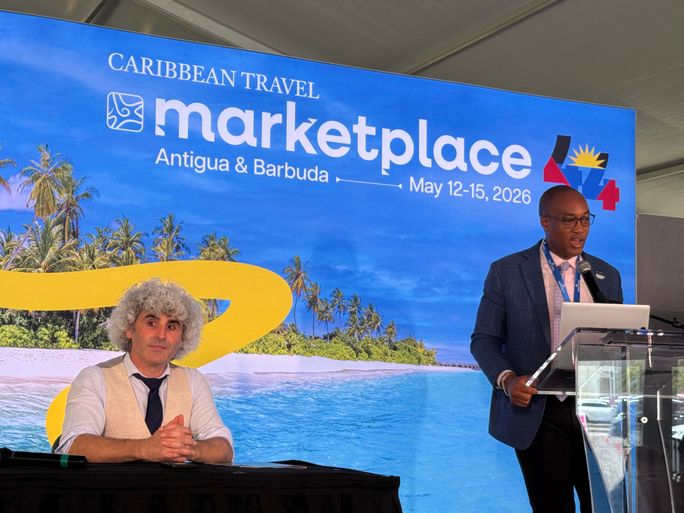
attendees at a press conference during the Caribbean Travel Marketplace, which
took place May 12-15 at the American University of Antigua in Antigua and
Barbuda. Despite losing some 90,000 seats from the shutdown, however, she added
that “we will be able to maintain our numbers from 2025 because we have the new
addition of Southwest, and also Breeze will be coming to the U.S. Virgin
Islands from Tampa in December. Overall, the U.S. Virgin Islands continues to
be strong in the market.”
The destination is now looking to Southwest, JetBlue and
other carriers to help fill gaps, according to Henneman. Southwest launched
nonstop service in 2026 connecting Orlando and Baltimore with St. Thomas, while
Breeze Airways is scheduled to begin nonstop Tampa-St. Thomas service in
December 2026.
The effect of Spirit Airlines' closure was just one of the
airlift-related issues that drove conversations at the Caribbean Travel Marketplace, organized
by the Caribbean Hotel and
Tourism Association (CHTA). Rising fuel prices, air connectivity, inflation and
geopolitical uncertainty all drove conversations throughout the event.
Monitoring Caribbean
Airfares and Markets
Spirit’s shutdown also affected other Caribbean
destinations, including Puerto Rico, the Dominican Republic, Jamaica, the
Bahamas and Belize.
“Spirit Airlines is a substantial airline in certain
destinations: Puerto Rico, USVI, it was in the top two or three, so there was
an immediate impact,” said CHTA president Sanovnik Destang. “What we’re also
seeing is that other airlines are coming in to meet that demand, because
there’s still incredible demand in the Caribbean.”
Still, there is a pricing challenge, he noted. “The airfares
at some of these destinations are starting to creep up,” according to Destang.
“The reality is that if the airfare becomes more expensive, it does put
pressure on demand.”
The Bahamas is among the destinations looking to maintain air
access. Dupree Smith, director of global sales for the USA, Southwest, Midwest,
West Coast and Northeast at the Bahamas
Ministry of Tourism, said the destination is in talks with multiple
carriers. “We continue to engage our airline partners across the spectrum to
see how we can bolster, increase service, maybe get one of our legacy carriers
to come in, fill in some voids and some gaps,” he said. “We’re fortunate,
though, that we also have a national carrier. It’s called Bahamasair, and it
operates out of South Florida, where Spirit was as well.”
Belize, however, now finds itself without a valuable,
market-expanding air service from Fort Lauderdale, according to Anoushka de
Boucherville, owner of Anoushka
Consultancy, a Belize-based tourism and hospitality company. “The most distinctive feature of this
loss is not raw seat capacity, as other carriers still serve Belize from
Houston, Dallas, Miami, Atlanta and other cities, but the demand segment Spirit
was unlocking,” she explained.
“Its ultra-low fares were converting price-sensitive families, first-time
international travelers, divers, and weekend visitors from South Florida who
simply would not have flown to Belize at twice the price.”

Philip Rose, Edmund Bartlett, Dona Regis-Prosper, Donovan White. (Photo Credit: CHTA)
Fuel Prices, Inflation
and New Routes
Even destinations not directly affected by Spirit are
watching the airlift situation closely for other reasons. Colin C. James, CEO
of the Antigua and Barbuda
Tourism Authority, said that air fuel cost pressures also affect legacy
carriers and make destination marketing more challenging. But he noted that his
organization’s targeting of luxury travelers should help minimize potentially
negative effects of rising airfares. “It supports our strategy of being [focused]
on the upper end of the market … the people who can afford to travel,” he said.
James also looks to diversification of source markets as
part of the growth strategy. “We are expanding our market, we are expanding our
reach, ensuring that we don’t have all our eggs in one basket so that even with
challenges around the world, we can compete and not just survive but thrive,”
he said.
That diversification is already visible in Antigua and
Barbuda’s airlift development. Sunrise Airways launched twice-weekly flights
linking Antigua with the Dominican Republic on May 1; Liat Air launched
twice-weekly Antigua-Guadeloupe flights on May 8; and Air Peace is scheduled to
launch twice-monthly Antigua-Lagos service on May 25.
Air Peace will also inaugurate flights to Barbados on the
same date, expanding that island’s connections to what the tourism office
describes as an emerging source market. Barbados also welcomed three new routes
by InterCaribbean Airways in March — linking the destination with Tortola,
Trinidad and St. Maarten; in addition, Copa Airlines is to up its service in
August, to daily flights between Barbados and Panama City, Panama.
Nevis, meanwhile, has new daily flights from St. Maarten,
Dominica has new service from San Juan and St. Thomas, and Jamaica is adding
Breeze service from Tampa in December 2026 — in addition to growing flights
from Latin America, the U.K. and Canada.
Olivier Ponti, Director of Market Intelligence & Insights, Hospitality, Amadeus & CHTA's Sanovnik Destang. (Photo Credit: DepartureLevel.com)
Jamaica’s Take and
Industry Research
Jamaica's
Minister of Tourism, Edmund Bartlett, said rising fuel prices and global
uncertainty are "headwinds that we have to contend with." But he also
pointed to the Caribbean's proximity to the U.S. as a competitive advantage.
"The fact that we're a shorter distance" helps, he said. "Load
factors are good, and that's a big incentive. We know that [fuel prices] will
impact a little, but we believe that it will not be as deleterious as it could
have been.”
That view is supported by Amadeus’ Destination
Insights: Caribbean Travel Trends 2026, which found that the average
U.S.-Caribbean economy fare is $385 — cheaper than South America and comparable
with or cheaper than Central America. The report described this as allowing the
Caribbean to remain “accessible and competitive.”
Saint Lucia is yet another destination taking a proactive
approach. Louis Lewis, CEO of the Saint Lucia
Tourism Authority, described the current airlift situation as one of
“capacity challenges.” He noted that while it’s difficult to predict the
market's future, European airlines have been able to hedge fuel costs farther
out. "We are very watchful … about developments and, to the extent that we
can adapt, we are willing to make adjustments.” Among those adjustments, he
added, is an acceleration of the island’s source-market diversification, with
increased focus on the Latin American market.
Continued monitoring is also the tactic espoused by Ian
Gooding-Edghill, Barbados’ minister
of tourism and international transport. “We do not see any indicators at this
point in time that has caused us to be extremely concerned,” he said, while
acknowledging that the geopolitical and pricing situations remain fluid. If
booking trends shift, he said, Barbados will take “appropriate response actions
to maintain the volume of air traffic as it is.”
For the latest travel news, updates and deals, subscribe to the daily TravelPulse newsletter.
Topics From This Article to Explore


