
by Lacey Pfalz
Last updated: 9:55 AM ET, Thu August 20, 2026
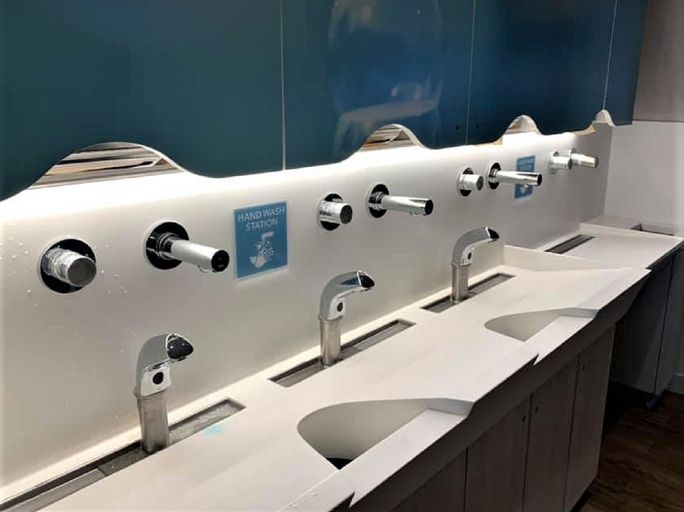
Handwashing Station on Symphony of the Seas (photo by Noreen Kompanik)
There’s been a lot of discussion around food-borne and easily transmissible illnesses—both at home and in the travel space.
So what about on cruise ships?
As some news goes viral over the terms “outbreak” and “inspection,” let’s break down the standards cruise ships are required to maintain by the Centers for Disease Control and Prevention’s Vessel Sanitation Program, which inspects and rates U.S.-based cruise ships and tracks cases of any GI-related outbreaks that occur onboard.
What is the Vessel Sanitation Program, and How Does It Work?
The Vessel Sanitation Program is a part of the CDC that directly inspects cruise ships based on health and safety criteria, primarily to prevent the spread of food-borne and human-to-human illnesses, specifically GI illnesses like E. coli and Norovirus.
As most cruisers know, close quarters can rapidly spread illnesses around; the VSP was created to limit the number of outbreaks that occur due to the ship’s maintenance and health and safety standards.
Cruise ships are routinely inspected through VSP, though not all of them. Regardless of where cruise ships sail, only those under VSP jurisdiction must undergo this inspection. Most U.S.-based cruise lines are under VSP jurisdiction.
Ships are inspected while docked in a U.S. port twice a year, at the cost of the ship’s owner. If a ship is outside the United States for an extended period, it may not be inspected twice, but will be upon return to a U.S. port. According to the CDC, inspections are comprehensive and take about a full day to complete. They are unannounced to reflect typical onboard conditions.
The inspector then catalogs every problem or issue the cruise ship has and how it can be resolved.
According to the reports, which are published online, some problems that could be identified include using a single pool net to clean two pools, instead of having one net for each pool, having inaccurate thermometers for fridges and coolers, and even more unsavory issues, like incidents of public vomiting or ill employees who continue to work while symptomatic, potentially spreading their illness to others.
Cruise ships also receive a rating for their inspection: anything over 86 is acceptable for health and safety, but anything under 85 is an immediate fail.
Cruise ships then submit corrective action reports describing what they did to fix the issues found, which inspectors revisit during a second random inspection.
Those that fail often have critical issues that must be corrected immediately. Cruise ships that failed previous inspections are inspected earlier than those that pass their first annual inspection, to ensure the corrections have been implemented.
The CDC rarely denies a cruise ship the ability to continue sailing, despite a ship’s failing grade.
Outbreaks: 2026 Versus Past Years
So how do cruise ships rate this year? How many outbreaks have there been since January, and how does that compare to previous years?
The CDC typically identifies outbreaks that include GI distress or symptoms, so while these numbers help measure activity, they don’t provide a full picture of what illnesses can spread in the close quarters of a cruise ship.
A sickness onboard is designated an outbreak if 3% of the ship’s crew and guests come down with the illness.
Last year, there were 23 verified outbreaks, mostly Norovirus. Many of these outbreaks occurred during the typical flu season, from November through March. There were also 18 outbreaks in 2024.
Since January 2026, there have been nine outbreaks, including two E. coli outbreaks, several Norovirus outbreaks, and a few unknown cases.
Additionally, cruise ship inspections have been positive this year: in the past 12 months, 50 cruise ships passed with a score of 100, the highest score possible.
In the past 12 months, there has been only one failing grade: the Norwegian Dawn, an NCL cruise ship, which was inspected this March and earned an 84, just under the mark to pass.
Some critical issues, which were corrected, included food service public health risks, such as too-warm walk-in fridges and fruit fly contamination of some crew food.
Overall, however, most ships in the past year have passed their inspections and quickly corrected the identified issues.
Changing Tides for the VSP
However, at the start of the second Trump Administration in 2025, most of the VSP’s full-time civilian staff were fired, despite the program not relying on taxpayer funding.
Only twelve U.S. Public Health Service officers and one epidemiologist remained to continue inspections and outbreak response during a spring when most of the year’s outbreaks occurred, the team about half as large as it used to be.
“Affected services include outbreak investigations, coordination with state and local health departments, follow-up on lab-confirmed cases of acute gastroenteritis after travel, and communications such as website updates,” Erik Svendsen, who led the CDC’s now-defunct Division of Environmental Health Science and Practice, which ran the VSP, explained when the lay-offs first occurred in March, 2025.
While inspections continue, the CDC’s ability to monitor, track and respond to outbreaks may not be as effective as it was in years past because of a lack of adequate staff. It’s unclear whether or not the gutting of the program has led to the decrease in outbreak reporting this year.
What You Can Do to Stay Healthy On a Cruise
While maintaining health and safety standards is critical to helping guests and crew stay healthy onboard a cruise ship, guests also play a critical role.
Travelers should always wash their hands before heading to the dining hall or buffet and avoid touching their face, coughing into their hands, or sneezing into their hands while handling food items, public surfaces, or shared utensils.
While it may seem like first-grade-level stuff, it goes a long way toward keeping illnesses from spreading.
Those who don’t want to get sick can wash their hands after meals, use hand sanitizer often, stay away from anyone coughing, and, if getting sick is a big risk, masking up really does go a long way toward illness prevention.
If you’re ill and don’t need any medication, try to social distance as best as you can. Pick places to sit in the sun away from most of the crowds, visit popular spaces like the cruise ship buffet during less crowded times, if possible (or order room service) and use hand sanitizer and wash your hands often, especially before touching shared items or utensils.
If you are really ill, need medication, or think you have a GI illness, report it to the ship’s medical staff, who can assess and treat minor ailments and illnesses. Reporting GI illnesses also supports the VSP’s outbreak response, since accurate numbers are crucial.
So Are Cruise Ships Healthy?
In conclusion, cruise ships are some of the most highly maintained public spaces for travelers.
High standards, thanks to the Vessel Sanitation Program, help ensure that food-borne and GI-related illnesses spread minimally in the closed-loop system of a cruise ship, and travelers have several ways to maintain cleanliness and prevent the spread of germs among themselves.
While the VSP has taken a significant hit in its ability to regularly inspect and respond to outbreaks due to the Trump Administration’s staffing cuts at the CDC, cruise ships continue operating at the same standards as before, with high passing grades for most U.S.-based ships.
While news about outbreaks and cruise ship cleanliness can go viral among social media and news outlets, it’s important to take a step back and assess the facts. Incidents certainly do occur, but they’re not as prevalent as in previous years, and illness outbreaks during routine sailings are not the norm.
For the latest travel news, updates and deals, subscribe to the daily TravelPulse newsletter.
Topics From This Article to Explore


