
by Brian Major
Last updated: 12:20 PM ET, Tue February 25, 2025
Government officials, international
tourism leaders and sustainability advocates are fast advancing strategies to
confront natural and man-made threats impacting their environments, communities
and livelihoods.
Leaders attending last week’s Global Tourism Resilience Conference in Hanover, Jamaica detailed
emerging strategies to promote environmental and economic sustainability and
resilience among tourism destinations threatened by unforeseen disruptions.
“For developing countries
in particular, tourism represents a path to empowerment, job creation, poverty
alleviation and the preservation of cultural heritage,” said Edmund Bartlett, Jamaica’s
tourism minister and co-founder and chairman of the Global Tourism Resilience and Crisis Management Center
(GTRCMC), the conference’s host.
“[Tourism] fosters cross-cultural
exchange, promotes tolerance, and deepens our shared sense of humanity,” he
said. “We must future-proof it.”
“Not only must we be prepared for changes that are beyond
our control [including] the climate, but we must also be prepared for changes
in policies in the global capitals of the world over which we have no control,”
said Andrew Holness, Jamaica’s prime minister, in an address to media during the
conference.
“The notion of resilience for us is not just one of the sexy
catchphrases that from time to time gets introduced into our vocabulary,”
Holness said. “Resilience is an important way of life and mindset. It’s about
being able to withstand exogenous shocks, absorb them and recover from them quickly
and better than we were before.”
“Events like COVID-19 have shown us the vulnerabilities of
our sector and the [need] to strengthen our capacity to anticipate, respond and
recover from crisis,” said Natalia Bayona, UN Tourism executive director.
“Resilience to me is not only about recovery. It’s about
[strengthening] our sector to withstand future challenges and safeguard
[tourism] jobs and businesses.”
Bayona pointed to Jamaica’s government as an example,
saying the country has launched a $9.9 million digital transitioning program to
foster digital infrastructure development “to promote innovation,” she said.
Said Bayona, “We are working to identify scholars and young
people to empower them and give them scholarships from the UN Tourism
Scholarship Program so we can bring Jamaicans to study [tourism] in different
parts of the world.”
UN Tourism has also established a digital hospitality
course that partners with destinations and utilizes WhatsApp, said Bayona. The
system has trained 500 taxi drivers in Columbia.
“In November it was a pilot. Now it’s a reality,” Bayona
said. “It’s a new service we are offering to member states.” She added UN
Tourism is also working with WhatsApp on models to train tourism personnel in emergency
response.
AI Application
Bartlett and other
attendees targeted the “digital transformation” as integral to building
sustainable practices to ensure tourism’s future. Digital tools, said Bartlett
can be utilized to “enhance visitor experiences, maintain
competitiveness and safeguard environmental and cultural assets.”
“Digital technologies [including] artificial intelligence and
emerging mobile applications hold the capacity to radically redefine how we
develop, market, and sustain tourism worldwide,” said Dr. Lloyd Waller,
GTRCMC’s executive director.
“These innovations promise greater efficiency, personalized
services and real-time data analytics, paving the way for smarter destination
management and enhanced visitor engagement.”
Said Bayona, “It’s very important that we’re talking about
digital transformation, because we need innovation to create better solutions.”
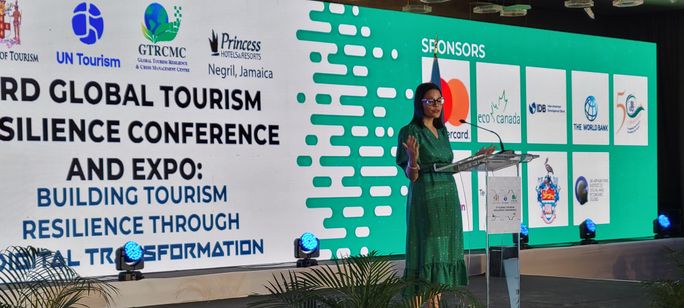
“It’s very important that we’re talking about digital transformation, because we need innovation to create better solutions.” - Natalia Bayona, UN Tourism executive director. (Photo by Brian Major)
“With generative AI, tourism boards can create compelling,
culturally appropriate marketing materials almost instantly,” said David Tepper,
Co-founder and CEO at Pay-i Inc. “They can be used to create blog posts and social
media content to creating stylized travel videos that highlight underrepresented
destinations.”
By utilizing data tracking customer feedback and seasonal
preferences, campaigns can be “highly specialized to the users viewing them,”
Tepper said, “making them more likely than ever to want to visit by telling
them customized stories covering exactly what they want to hear.”
Seamless Connections
Bartlett identified AI as having “given us useful tools to
make the travel process seamless. Since its emergence the tourism industry has
utilized AI to improve features like customer experience, reduce costs and streamline
operations,” he said.
“It has been transforming our industry from the initial
spark of deciding where to travel and the pre-planning that goes into visiting
the destination, all the way to departure,” Bartlett added.
“Tools like chatbots [that] streamline air and hotel
bookings to automation at the airports to optimize baggage handling and reduce
delays.”
In recovering from the global pandemic, Greece’s government
“used AI tools in a very innovative way, to get more high-risk people tested as
opposed to just doing general testing,” said Haris Theoharis, a Greek
parliament member and former tourism minister.
“This way we were able to control our borders and convince
our doctors that it was safe crossing our borders. We were able to collaborate
across ministries and assure we were accepting [visitors] with more assurance.”
Bartlett added that U.S. travel advisors are utilizing AI
tools to aid their booking processes, boosting visitor numbers for Caribbean destinations.
“Perhaps one of the most interesting tools it has given us
is the AI [-assisted] travel agent that can assist with complex travel requests
[by] searching online platforms for recommendations and developing itineraries,”
he said.
Yet while consumers are increasingly using AI tools to research
travel options, “they're still doing their due diligence of researching on
their own through the online travel forums and working with trusted travel advisors,”
said Bartlett.
“I want to make that very clear the human element of travel
is irreplaceable,” he said. “Only humans can provide insights into
particularities like the best time to visit a location for an excursion or who
at the hotel mixes the best drinks.”
Said Bartlett, “Authenticity is still an important aspect
in travel planning in the travel planning process and we don't see that
disappearing anytime soon.”
“When you have events like a global pandemic, we have
different approaches and different policy decisions, and different ideologies
that drive those decisions,” said Theoharis.
“What is important is we have centers like (GTRCMC), with
solutions that can access global issues and through that assessment ensure that
we highlight best practices,” he said.
“If we know one thing we know for sure, it’s that new
crises will arise, more often and stronger than before with bigger
consequences.”
For the latest travel news, updates and deals, subscribe to the daily TravelPulse newsletter.
Topics From This Article to Explore


