
by Brian Major
Last updated: 10:20 AM ET, Sat January 17, 2026
Jamaica’s comeback from the devastation wrought by Hurricane
Melissa is an example of the destination’s stalwart resilience in the face of
disaster, said Edmund Bartlett, the minister of tourism.
He called the storm unprecedented, saying: “In Jamaica we’ve
never experienced this sort of disruption of a category what storm. We say category
5 but it’s 5-plus. All of the meteorologists and scientists who are involved in
climate science are trying to determine what was the nature of the storm. Jamaica
endured 185 m.p.h. winds and gusts of 252 mph; many people thought it was an
earthquake, not a hurricane.”
Speaking to media at a New York luncheon, Bartlett said he
storm wrecked about one-third of the island. “With all of that Jamaica lost 28
to 32 percent of our GDP, that cost us anywhere between eight to 10 billion
dollars,” he said. “One and one-half million people were affected and 157,000
buildings impacted in one way or another.”
Jamaica’s public and private sectors worked hard to ameliorate
hardships on travelers in the storm’s wake. The country re-patriated 25,000 tourists
from around the island “without any having damage to their person or property,”
Bartlett said.
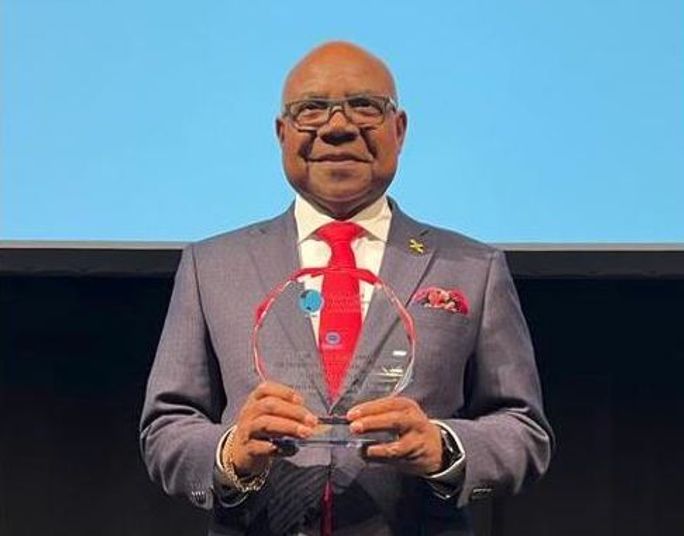
Jamaica's Edmund Bartlett displays his lifetime achievement award presented by the Pacific Area Travel Writers Association. (Photo Credit: Ministry of Tourism, Jamaica)
Meanwhile, government leaders quickly went into action. “We
established a recovery task force one day after the storm, Bartlett said.
“And within eight weeks, this little country, the size of
the King’s Ranch of Texas, was able to bring back 80 percent of the power
supply and 83 percent of water processing.”
“Resilience is in our D.N.A.,” said Bartlett. “We established
the Global Tourism Resilience and Crisis Management Center and for the last five
years we have been providing thought leadership in this area to mitigate and
manage crises and most importantly to recover quickly.
Jamaica proved its comeback ability during the Covid-19
crisis, said Bartlett. “Three months after Covid was declared worldwide, we
opened our doors to visitors. We established a resilient corridor which was a
benchmark to have visitors come into a country, protect them from the Covid virus
and enjoy a less than one percent rate of infection.
“That is the resilience we have brought in responding to the
Melissa crisis,” he said. “I declared that 90 days after the hurricane we would
open our doors and we did. And since then we have welcomed half a million visitors
to Jamaica.”
The hospitality sector is up and running. “We were able to bring
back workers; open 70 percent of our hotel properties, we have some 30 percent
that are being managed for a fast recovery. Some will open the first of February,
others in March and April, June and October. By the last quarter of 2026 we
will have 95 percent of our capacity back.
Jamaica benefits from strong air links and technological savvy
that includes airport facial recognition technology. “We are the most connected
Caribbean destination today,” Bartlett said. “Anywhere in the U.S. you want to
travel from, you can get to Jamaica. Any airline that operates south of the border
passes through Jamaica.”
For the latest travel news, updates and deals, subscribe to the daily TravelPulse newsletter.
Topics From This Article to Explore


