Cruise lines are paying more attention to food and
beverage than ever before—and passengers are arriving with expectations to
match.
“Food sells cruises, and it wasn’t like that 20 years
ago,” asserted John Mulvaney, director of culinary operations at Holland America Line,
at a panel discussion during F&B@Sea. The trade show—part of the broader Seatrade
Cruise Global event—took place at Miami’s
Mana Wynwood Convention Center the third week of April, bringing together
cruise line professionals, suppliers and hospitality leaders.
Reflecting the growing importance of cruise
culinary operations, this year’s F&B@Sea drew record-breaking attendance
and featured 230-plus vendors, making it the largest iteration of the
conference since it debuted in 2023.
Experiential Dining Emerges as
Key Trend
The newly released Cruise
Food & Beverage Trends Report 2026 from
Seatrade Cruise—based on insights from 163 cruise buyers and suppliers—reflected
two key priorities: experiential dining and global flavor exploration. In fact,
80 percent of respondents pointed to experiential dining as a key trend, as
cruise lines blend cuisine with entertainment and storytelling.
Cruise line executives discussed those themes
and more in two enlightening panel discussions at the show: “Beyond the Horizon:
The New Era of Cruise F&B” and “From Port to Plate: Delivering Authentic
Local Flavors at Sea.” Here are five trends these leaders noted that are
reshaping culinary offerings onboard cruise ships.
Dining
Has Become a Booking Decision
It’s no longer enough for cruise lines to offer a good
meal—guests are choosing their cruise line based on the food. “Culinary F&B
is really now a deciding factor in how guests choose to book from brand to
brand,” said Marisa Christenson, associate vice president of food and beverage operations
and development at Holland
America Line/Seabourn.
“They’re looking for a place they can connect—connect with the guest
experience, connect with the destination—and F&B is very much a big part of
that. So it’s a differentiator.”
For a line like Holland America, known for its longer
itineraries, culinary variety is essential—and it takes guest feedback
seriously. “We absolutely listen to that feedback—down to the details of how
well our toaster is toasting in the Lido Market,” said Christenson. “We hear it,
and we make sure we address it.”
While most travelers place a high emphasis on dining—98
percent of vacationers research where they’re going to eat, said Linken D’Souza,
senior vice president of food and beverage operations at Royal Caribbean
International—cruise lines have a captive audience,
which presents a unique opportunity. “We have the biggest ships, and we have
experiences for everyone,” said D’Souza. “We still have the traditional buffets
and dining rooms, but we have QSR [Quick-Service Restaurant] experiences, fine
dining experiences, immersive dining experiences. We’re creating a palette for
all customers to be able to enjoy the vacation the way they want to enjoy it.”
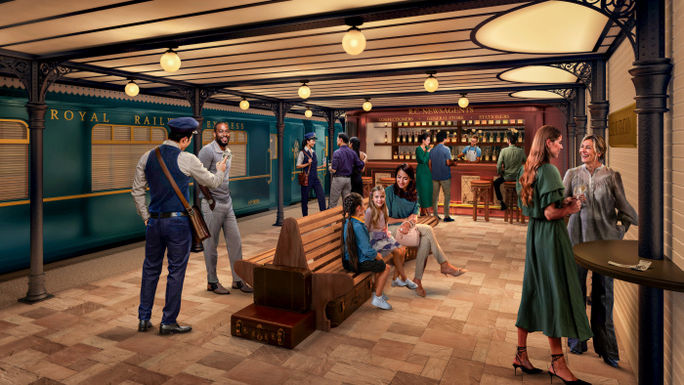
Royal Caribbean’s Royal Railway is an example of the line’s “eatertainment.” (Photo Credit: Royal Caribbean International)
“Eatertainment” Is the New Dinner
Theater
Themed, theatrical dining experiences are no longer a
novelty—they’re a competitive priority. Royal Caribbean has coined the term “eatertainment”
for the spectrum it now offers, from casual sports bar games to fully immersive
dinners.
D’Souza described the line’s “revolutionary concept,”
the Royal Railway on Utopia of the Seas and the upcoming Legend of the Seas. “It’s
a train on a ship where we have an immersive dining experience—sound, ‘butt-kickers’
in seats, actors, a whole variety of different effects that give you an
experience”—paired with a five-course meal. The concept was rigorously tested
in Royal Caribbean’s innovation lab before launch. “We built up a whole train
car, put executives through it, put employees through it, and we go through the
food, the service, the acting—we get feedback in real time,” said D’Souza.
Holland America’s new Koningstafel, Dutch for “King’s
Table,” is a “high-touch dining experience” that takes guests through the
galley during peak service so they can get a behind-the-scenes look at a
kitchen’s hustle and bustle, said Christenson. The six-course feast debuted on
Oosterdam and is available on cruises of 14 days and longer. “We’re working
with our entertainment team right now on a fun new initiative in our dining
rooms on the last night of the cruise,” added Christenson.
The
Menu Should Tell the Story of Where the Ship Is Sailing
“People want to see where they’re sailing, and they
want to taste where they’re sailing,” said Mulvaney. When guests go ashore and
try local cuisine, Holland America carries that authenticity through to what
they’re serving onboard. “We call it the ‘arc of the cruise,’” he added.
That authenticity requires intentional staffing as
much as sourcing. “We’ve got a large demographic of chefs from Latino, Asian,
European and South Asian backgrounds,” said Mulvaney. “If the ship is sailing in
a particular area, we send more chefs on board who actually come from
there—because reading a recipe and cooking it will never be authentic. You need
someone who has eaten that dish their whole life.”
Menu language has evolved to match. “Gone are the days
when you could just put ‘Chicken Hawaiian-Style’ on the menu,” said Mulvaney. Now
a traditional Hawaiian dish will be served with its proper name and prepared
correctly—“because your customers know,” he added.
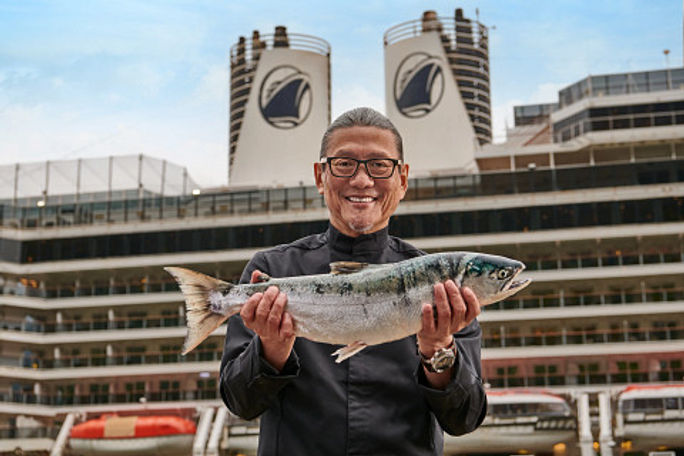
Chef Masaharu Morimoto is the ambassador of Holland America Line’s Global Fresh Fish Program. (Photo Credit: Holland America Line Media)
And storytelling is part of the craft, noted Mulvaney:
“You’ve got to tell the story. You’ve got to make it visible on the menu.”
Explora
Journeys is taking destination dining further with a new
program launching on Explora III this summer, allowing guests to build their
own menus for intimate, private celebrations. “Say you’re in the south of
France and you want to have a zucchini flower stuffed with porcini mushroom,”
said Alban Gjoka, vice president of food and beverage for Explora Journeys. “You
can take the chef, go in the market in port, buy your sustainable produce, and
then come on board to help craft the meal. Then the wine concierge will be
suggesting what to pair with that dinner.”
Guests then watch their special meal being prepared
just for them in an open kitchen for a private chef’s table experience. “We are
building an emotional connection,” said Gjoka.
Guests
Expect Transparency
Executives agreed that today’s guests want to know
where their food comes from—and they want it to mean something. “There is a
very clear rising expectation of transparency in sourcing—where our products
come from, how they were sourced and who we choose to partner with,” said
Christenson.
Holland America’s Global Fresh Fish Program is a
direct response to that demand—securing more than 80 species of fresh fish from
60 ports worldwide, with a commitment to “port to plate” within 48 hours. “The
fish dish that you have in the dining room is really going to vary based on
where you are in the world,” said Christenson.
In fact, cruise lines have transformed their
purchasing operations to meet this demand. “We do a lot more local purchasing
today than we ever did before,” said Peter Tobler, director of food and
beverage operations for Windstar
Cruises.
The desire for transparency stems from travelers’ increased
food knowledge, noted Mara Papatheodorou, a tastes and traditions expert who
works with ATLAS
Ocean Voyages. “Travelers are much more aware of the
culinary world,” she said, thanks to food media, documentaries and social media.
“They do travel with their palate and their curiosity.”
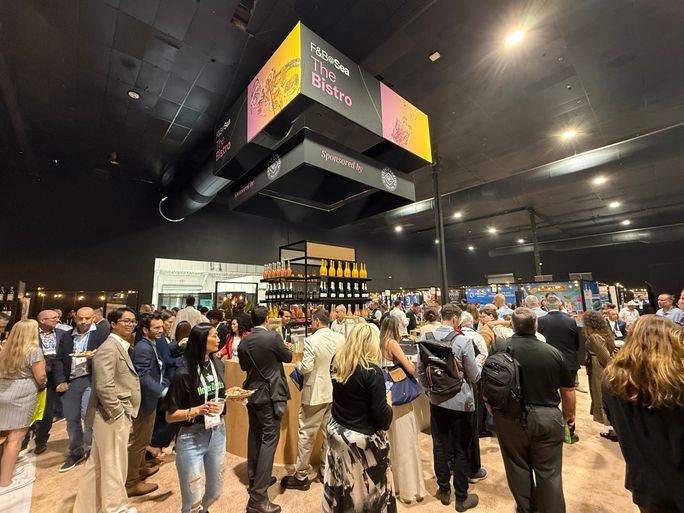
F&B@Sea brings together cruise line professionals, suppliers and hospitality leaders. (Photo Credit: Sara Perez Webber)
Connection
Is Still Key
Beyond cuisine itself, the act of dining together
remains one of cruising’s most distinctive selling points. “The ability to come
together and have a family dining experience is kind of lost in the modern
world,” said D’Souza, pointing to busy lifestyles and meals eaten in front of
the TV, mobile devices in hand. “When you’re on vacation, it’s an opportunity
to reconnect, engage with family and friends, enjoy that time together, and
really create special memories that last a lifetime. What’s great about the
experience on board ships is that guests can come together in ways that they
used to.”
Despite the proliferation of specialty dining options,
both D’Souza and Christenson believe that the traditional dining room will
always have a role to play in cruising. “I think people still want both,” said
Christenson. “There’s nowhere else in the world where you’ll get to know your
waiter like you do on a cruise ship. Maybe the fixed seating isn’t as popular,
but we still absolutely honor that tradition, and have a lot of people
expecting that. It’s about flexible dining and giving people choices and really
what they want.”
Ultimately, the evolution of cruise cuisine is about more than menus,
sourcing or specialty dining. It’s about connection—to destinations, to culture
and to one another. As Papatheodorou put it: “Travel empowers us. It transforms us. And
from port to port, and dish to dish, the world really does become a smaller
place around the table.”
For the latest travel news, updates and deals, subscribe to the daily TravelPulse newsletter.
Topics From This Article to Explore


