
by Mia Taylor
Last updated: 6:30 PM ET, Thu August 1, 2024
The killing of senior leaders from Hamas and Hezbollah this week has further destabilized an already fragile situation in the Middle East and concerns are growing that there may be an all-out regional war on the horizon.
The two assassinations took place in Iran and Lebanon and Israel is being blamed for both. Ismail Haniyeh, one of the top members of Hamas, was killed during a state visit in Iran for the inauguration of the country's new president, while senior Hezbollah commander Fouad Shukur was killed in Beirut.
In the wake of the killings, the U.S. State Department has issued advisories for those traveling to the region or contemplating future travel.
As of July 31, Lebanon is the subject of a Level 4 travel advisory, which means travelers should avoid the country. The State Department cited “rising tensions between Hezbollah and Israel” in its advisory for the country.
Similarly, the State Department has issued a Level 4 Do Not Travel advisory for Northern Israel. Specifically, the government agency advises travelers to avoid going “within 2.5 miles of the Lebanese and Syrian borders." This too is due to the rising tensions between Hezbollah and Israel.
For the remainder of Israel, the State Department advisory is Level 3 - Reconsider Travel. Here too, the concern is ongoing conflict in the region, as well as potential acts of terrorism.
Meanwhile, United and Delta Air Lines announced that they’re pausing service to Tel Aviv. Delta said yesterday that flights between New York-JFK and Tel Aviv will be paused through Friday, August 2, “due to ongoing conflict in the region.”
The airline also said in its statement that it will continue to assess the worsening regional conflicts in the Middle East and respond accordingly.
United also intends to temporarily pause flights operating between New Liberty International Airport and Tel Aviv’s Ben Gurion Airport.
"We have suspended for security reasons our daily Tel Aviv service as we evaluate our next steps,” United confirmed to Travel + Leisure in a statement today. “We continue to closely monitor the situation and will make decisions on resuming service with a focus on the safety of our customers and crews.”
So what does it all mean if you’re an American traveler who may be visiting the region in the future? Or who is already there?
To help answer that question, TravelPulse spoke with international security expert Seth Krummrich, who in addition to being vice president of international security provider Global Guardian, is a retired Army colonel with 20 years experience serving in the Middle East as chief of staff for Special Operations Command Central in the U.S. Central Command.
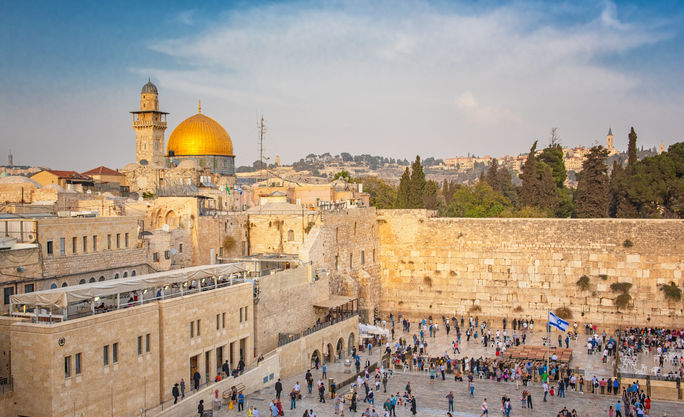
Old City of Jerusalem, Israel. (Photo Credit: Horváth Botond/Adobe)
The risk of the coming weeks and months
In the days after Hamas’ October 7 attack on Israel, Global Guardian evacuated more than 1,100 people from Israel and continues to support clients who are currently traveling throughout the region, including American families and staff from Fortune 1000 companies.
While maintaining optimism about the long-term prospects for the Middle East, Krummrich largely advises avoiding travel in the immediate future, unless its absolutely necessary.
“For every client I have in Israel that’s traveling and doing work there, I ask ’Is your current travel critical for your business’ continuity model? And if it is, then I advise taking some risk reduction measures,” Krummrich told TravelPulse. “But in cases when it’s not critical or its routine travel, I suggest now is a perfect time to delay travel.”
“I understand people want to visit, but visiting when things aren’t quite as elevated is the perfect time to visit,” Krummrich adds.
The coming few days and weeks appear to be especially concerning, as Krummrich said it’s inevitable that Iran will respond in some way to the strike on Ismail Haniyeh, a Hamas top leader who was killed while under the protection of Iran.
“Iran has to respond,” Krummrich continued. “They have a lot of leverage they can pull, but make no mistake they don’t really have a choice here but to respond - because this was such an extraordinary assassination and strike. First because of where it was and second because this was a guy who was in Iran for a presidential inauguration. The attack was such a huge security failure for Iran that they have to do something.”
Where you go in the Middle East matters
Much like the nuanced State Department advisory, which is Level 4 for Northern Israel, but Level 3 for the rest of the country, Krummrich also offered regional variations in his travel advice.
Where you’re visiting in the country, he says, makes a significant difference.
“Despite what happened on October 7 and the surprise aspect of [Israel’s air defense system] the Iron Dome being overwhelmed, it is extremely difficult for rockets to make it to Tel Aviv,” continued Krummrich. “I have had clients in and out of there since October 7 with no issues.”
Krummrich said it’s also still possible to travel to the West Bank, but offered some overarching guidance - a check-list of questions to ask yourself - before embarking on a visit to the region right now.
His tips include:
- Ask yourself whether you really need to go.
There are some companies whose employees do still need to visit the region. And in that case, Krummrich advises taking risk reduction steps. (A global security firm can help with this. ) But if you don’t fall into this category, it’s worth waiting, says Krummrich. - Have a partner.
At the risk of sounding like an advertisement for his own company, Krummrich strongly advises those visiting the region to have a partner in place before you visit the Middle East who can track your movements in the region and evacuate you if needed. Not all global security firms provide evacuation in such situations, so be sure you ask about this.
And if not a global security firm, make sure you have some other partner who is prepared to evacuate you in an emergency.
You should know the answer to the question: “Who is going to come get me?”
“If
they were to close all commercial airlines down, how are you going to
get out?” Says Krummrich. “Do you have a partner that can get you out?"
For
instance, Global Guardian recently had to rescue clients from the
region and had team members on the ground who drove the clients to the
Jordanian border and to safety.
"Our Jordanian team picked them up and drove them to Amman and then they flew out,” explained Krummrich.
Bottom
line if you plan to travel to the Middle East? Make sure you have a
plan, you are informed and you have done your homework ahead of time.
The path ahead
As
for what the future holds in the Middle East in terms of the peace
process, travel prospects and the massive rebuilding that must take place
in Gaza - that is perhaps the most complex and daunting question of them
all, says Krummrich.
The short answer is that the heightened
regional instability is not likely to end quickly, particularly between
Israel and Gaza. And even long term, specific parts of the region are
likely to remain more problematic than others for years, if not decades
to come.
“Israel and Gaza is going to go on for a while,” says
Krummrich. “But what concerns me the most is Gaza. Beyond the loss of
life and beyond the humanitarian crisis, I don’t see any long-term
plan.”
Gaza’s future remains a giant question mark, says
Krummrich. It’s not clear who will govern Gaza once the war is over, not
to mention who will spearhead the massive undertaking that lies ahead
in order to restore the basic requirements for day-to-day life in a
place that’s been largely reduced to rubble - everything from operating
schools and hospitals to collecting garbage, must somehow begin again.
“When
you don’t have those things in place you are in trouble, the real
complex problems are ahead of you, not behind you,” says Krummrich.
For the latest travel news, updates and deals, subscribe to the daily TravelPulse newsletter.
Topics From This Article to Explore


