The Federal Aviation Administration (FAA) is implementing a new measure to enhance safety at the nation's airports as it pertains to helicopter traffic.
Citing two recent near-miss incidents in Texas and Southern California, U.S. Transportation Secretary Sean Duffy and FAA Administrator Bryan Bedford announced a general notice (GENOT) suspending the use of visual separation between airplanes and helicopters on Wednesday.
The measure, which comes more than a year after a fatal mid-air collision involving an American Airlines regional jet and an Army helicopter over Ronald Reagan Washington National Airport, requires air traffic controllers to use radar to actively manage both aircraft to keep them separated at specific lateral or vertical distances.
The order applies to Class B and Class C airspace as well as and Terminal Radar Service Areas (TRSA) where helicopters cross airport arrival or departure paths.
"Visual separation occurs when air traffic controllers advise pilots about nearby aircraft and allow them to remain visually clear of the other aircraft, in lieu of standard separation," according to the agency. "The FAA's data analysis revealed for high-traffic areas, visual separation was not enough of a safety mitigation tool."
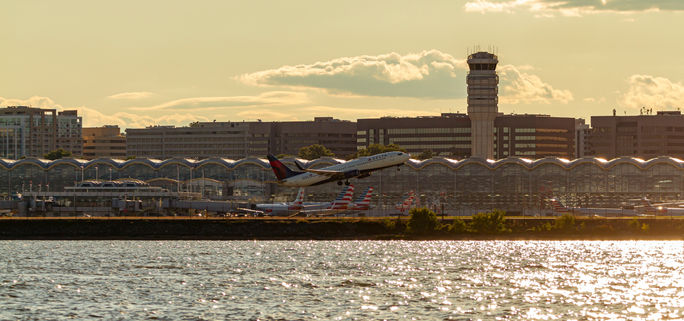
Plane taking off from Ronald Reagan Washington National Airport. (Photo Credit: Adobe/Grandbrothers)
The new order comes less than three weeks after an American Airlines flight was cleared to land at San Antonio International Airport at the same time a police helicopter was flying through the airport’s final approach path. "The helicopter and aircraft were on converging courses when the helicopter made a left-hand turn to avoid the American Airlines flight," the FAA confirmed.
Meanwhile, earlier this month, a Beechcraft 99 was cleared to land at Hollywood Burbank Airport while a helicopter was flying through the final approach path. In this case, the helicopter made a right-hand turn to avoid the Beechcraft.
"The tragedy over the Potomac one year ago revealed a startling truth: years of warning signs were missed, and the FAA needed dire reform. Since then, we’ve implemented numerous changes to protect the skies over our capital and keep the traveling public safe," Duffy said in a statement.
"But the job isn’t done. Using innovative data analysis, the safety team at the FAA has identified the need for enhanced protocols at all airports across the National Airspace System. The Trump Administration will continue to act decisively to keep you and your family safe when you fly," said Duffy.
"Today, we are proactively mitigating risks before they affect the traveling public," added Bedford. "Following the mid-air collision near Ronald Reagan Washington National Airport (DCA), we looked at similar operations across the national airspace. We identified an overreliance on pilot ‘see and avoid’ operations that contribute to safety events involving helicopters and airplanes."
For the latest travel news, updates and deals, subscribe to the daily TravelPulse newsletter.
Topics From This Article to Explore


