“Welcome to Antarctica!” the expedition guide exclaimed as
she helped me off the Zodiac.
We’d already been to Antarctica
for the past few days, seeing various islands off the mainland. We’d even had
an onboard lecture discussing what truly constituted “Antarctica” for the
purposes of world-exploring. That’s open to interpretation, with some
yardsticks even counting our call at South Georgia, hundreds of miles across
the ocean, as our first Antarctic stop.
In the previous days, we’d already set foot upon Penguin
Island—much closer to the Antarctic mainland—which was good enough for me. Similarly,
Catalina Island is part of the North American continent; so, if I’d been to
Catalina, I could just as easily have claimed to have visited California, the U.S.
and North America, and I didn’t view Antarctica any differently.
But the fact that we were—for the first time—on the
Antarctic mainland wasn’t lost on many of the other passengers onboard our
chartered Abercrombie
& Kent ship. Some visitors had their photos taken with their national
flags in a bit of expedition cosplay, perhaps unaware that they were among some
100,000 visitors to Antarctica each year. That’s about as many visitors as
Disneyland gets on a weekend, so it puts Antarctica in somewhat more rarefied
territory, but not perhaps flag-planting territory.
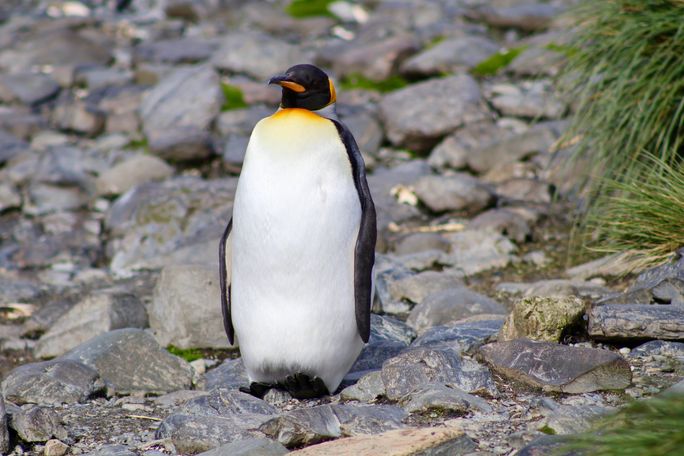
A King penguin in Antarctica. (Photo Credit: Northstar Travel Group/Scott Laird)
Who’s In Charge of Antarctica Tourism?
The number of visitors to Antarctica is a concern, mostly
because of the continent’s unique geopolitical situation. Seven sovereign
states claim territory in Antarctica, and some of the claims are overlapping. Not
only does that mean there are no residents or economy for any tourism to
benefit, but it also complicates the regulatory situation. Who fines an
operator for not following the rules?
Many tour operators (including both Abercrombie & Kent
and Ponant,
the operator of our ship) are members of the International
Association of Antarctic Tour Operators (IAATO), which sets standards for
member operators. Members must adhere to IAATO’s standards, but the only real
punishment for violations is expulsion from the association. IAATO membership is
also not required for operators to offer tours to Antarctica.
Legally, Antarctica is governed under the Antarctic Treaty
System, a set of international agreements under which signatory nations manage
environmental protections on the continent. Tourism policy is set by the Antarctic Treaty Consultative Meeting
(ATCM), a body comprised of state signatories to the Treaty, including
Argentina, Australia, Belgium, Brazil, Bulgaria, Chile, China, Czechia,
Ecuador, Finland, France, Germany, India, Italy, Japan, South Korea,
Netherlands, New Zealand, Norway, Peru, Poland, Russia, South Africa, Spain,
Sweden, Ukraine, United Kingdom, United States and Uruguay.
Only representatives from those countries have standing to
set policy at the meetings, although IAATO is invited to the discussions as an
outside expert. Individual visitors are also held to account for their actions
while on the continent, especially if their country is a signatory of the
treaty; most of those countries have companion laws that enforce the treaty
obligations on its citizens. U.S. citizens are individually liable to
prosecution in U.S. courts if they personally violate the Antarctic
Conservation Act (ACA).
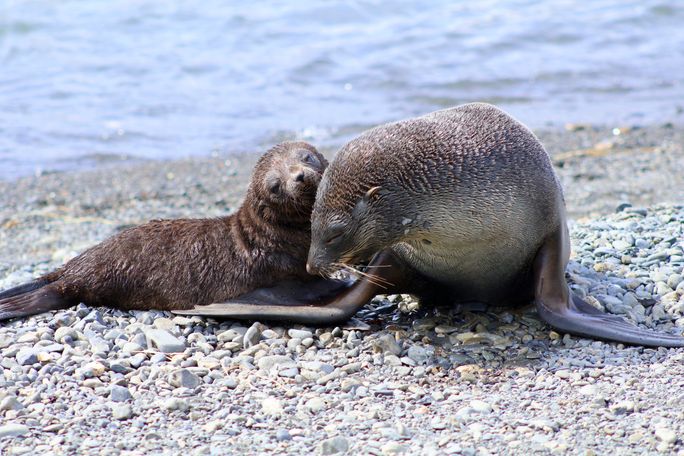
A mother fur seal and her pup on the shore in Antarctica. (Photo Credit: Northstar Travel Group/Scott Laird)
A Crowded Continent?
During our voyage, we had the fortune of being the only
cruise ship around on most days. We had the Falklands and South Georgia to
ourselves, and we really only encountered other ships on two of the days we
were in Antarctic waters—generally in passing. While anchored in Neko Harbor, a
landing party from the Russian ship Amazone (which isn’t an IAATO member) drew
some clucks from the expedition team, who observed their guests were climbing
up on a nearby glacier. It used to be more common, they said, but hasn’t been
done by most operators for years because of hazardous hidden crevasses in the
glacier.
Aside from Neko Harbor, the only place we really shared a
landing spot was on Petermann Island, and the other group was no more than a
single Zodiac-full, and we didn’t mingle. We were off to see a colony of Adélie
penguins and Gentoo penguins waddling along the “penguin highways” trodden in
the snow between their colonies and the ocean. We were carefully warned not to
walk on the penguin highways on our own, lest it upset their cycles.
In addition to not walking on the penguin highways, the list
of rules we needed to follow to adhere to IAATO guidelines was impressive.
Sitting, crouching, kneeling—basically touching the ground with anything but
the bottom of our boots, a hiking pole or a camera tripod was forbidden, as
that’s been linked to transmitting avian flu. All our gear needed careful
cleaning at various points throughout the journey, and we also had to sign
acknowledgements that this had been done.
One of the limits imposed by IAATO is that ships carrying
more than 500 passengers cannot make landings in Antarctica—none of the sites
surveyed by IAATCO and discussed at the ATCM were evaluated as being able to
handle groups larger than that size. On ships larger than 100 passengers,
landings must be done serially, because there’s also a group size limit of 100
for each individual landing. Some cruise lines cap passenger numbers even
further. Aurora
Expeditions limits sailings to 130 passengers, and even our ship, which can
carry up to 264 passengers, was limited to 199 so that only two groups were
needed to get everybody ashore.
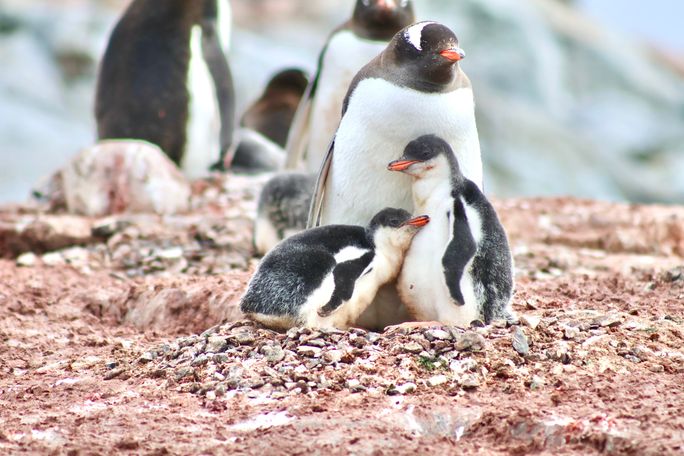
An adult Gentoo penguin with its chicks in Antarctica. (Photo Credit: Northstar Travel Group/Scott Laird)
The Experience
On the ground in Antarctica, it was a little easier to enjoy
the trip with the assurance that we were doing everything by the book. There
was nothing quite like the feeling of stepping off a Zodiac into the waves
breaking on shore to be immediately charged by a group of baby fur seals with
their funny little gallops and their tentative growls and croaks.
“They’re really just trying it out,” one of the guides said.
“They do it to each other, too—they’re testing out their capabilities and find
out their limits.”
Where the fur seals were expressive, the penguins seemed
almost dismissive, waddling among the expeditioners wading ashore as though
they were part of the scenery, completely unaware of the regulation that says
the humans have to keep at least 15 feet away. In the Falklands, we saw Rockhopper
Penguins, King Penguins on South Georgia, and Chinstrap, Gentoo and Adélie
penguins in Antarctica.
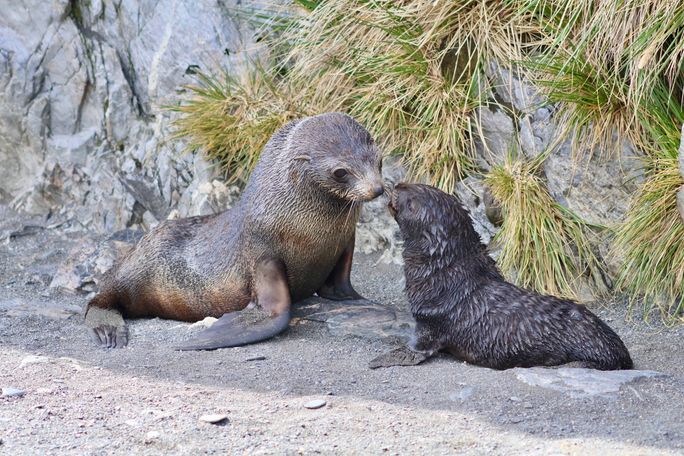
A pair of fur seal pups seen in Antarctica. (Photo Credit: Northstar Travel Group/Scott Laird)
The Takeaway
I wasn’t sure I’d get any sort of ethical clarity about
visiting Antarctica after my trip there, and I still haven’t entirely worked
that out. Penguins are sadly one of the most vulnerable bird species on the
planet, with some scientists suggesting many species of penguin will be extinct
in the wild by 2100, so I had some sense of accomplishment for having seen them
in the wild, and a renewed interest in protecting the fragile Antarctic
ecosystems where they live.
But at the same time, I still haven’t been convinced that
annual hordes of tourists are the answer. For now, I appreciate that their
numbers are still low, landings are tightly stage-managed, and the huge
continent of Antarctica sees tourism in only a small sliver (it’s as if
visitors to the U.S. only visited the coast of Maine, leaving the rest of the
country untouched).
For now, it feels ok. As far as future tourism growth—it’s
got my attention.
For the latest travel news, updates and deals, subscribe to the daily TravelPulse newsletter.
Topics From This Article to Explore


