
by James Ruggia
Last updated: 4:24 PM ET, Mon February 10, 2014
On Feb. 9 Liverpool Marketing came to New York's Hard Rock Café on Times Square to commemorate the 50th anniversary of the Beatles Feb. 9, 1964 appearance on the Ed Sullivan Show.
It was one of those events that gets many Americans of a certain age remembering, or at least, imagining they remember where they were that night 50 years ago.
At the event on Sunday, members of New York's travel industry treated to a performance by the Cavern Club Beatles, the house band of Liverpool's Cavern Club, an original Beatles venue and now a major station on Liverpool's Beatlemania circuit.
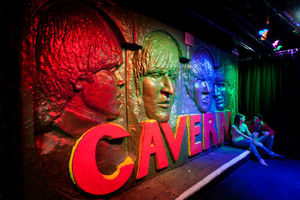
PHOTO: The Cavern Club in Liverpool.
Many imagine Liverpool as a tough grimy rust bowl remnant whole only real claim to fame is as the industrial incubator that gave the world the Beatles. At more than 800 years of age, the city is much more than that in historic significance and as a pleasant destination for visitors. The town has some of the best shopping in the U.K., great museums, bars and restaurants.
It was once second only in significance to London in the financial rankings of the U.K.'s as the city played a major role in the industrial revolution as a port connecting the mills of Northern England with the cotton plantations of the American South. It was also a leading departure port for emigrants to the Americas.
For those reasons and because was an important catalyst in the expansion of the British Empire, UNESCO made its waterfront a World Heritage Site.
As Duncan Frazer, Liverpool Marketing succinctly put it, "Liverpool was always strong; the Beatles only made it stronger."
While Liverpool's tourism potential may seem obvious now, that's a relatively new state of affairs. Liverpool tourism took off in 2008, when it became the European Capital of Culture. In the lead up to its turn as European Capital, the city invested more than $80 million in the arts; $46 million on building renovations and another $21 million on marketing, for a total budget of $166 million.
It reaped an estimated £800 million ($1.3 billion) in economic benefits from its turn as European Capital, almost all of it coming from tourism.
When the city government saw the very real impact tourism had on the city's profile, its stature and its economy, it allowed private interests to assume more responsibility in Liverpool's tourism marketing whereas before it had been overseen by the City Council. The Beatles as a full-fledged tourism driver really began about seven or eight years ago."
"Really Liverpool has two major hooks: our football clubs and the Beatles," said Frazer. "Football is a major market in the U.K., Europe and other football (soccer) loving markets, but the Beatles are popular everywhere, especially in North America.
"But let me be clear, in the U.K., after London and Edinburgh, we have the strongest offer for tourists. Exploring the Beatle legacy alone will take a couple of days for a visitor and then there's a lot more to discover and we are also a strong headquarters for exploring a wonderful region."
In Liverpool's immediate region tourists staying in the city can easily visit Manchester, Chester, the Lakes District, play golf on any of seven courses laid out along the coast and a lot more. The city itself is just a two-hour direct train ride from London, with superb service by Virgin Trains.
Happily for Liverpool, Beatlemania may not be as maniacal as it was when the Fab Four were chased through the streets of Liverpool by mobs of adoring teenagers, but it maintains a remarkable staying power. "We've now seen three generations of devoted Beatle fans," said Frazer.
The Beatles circuit in Liverpool includes the Beatles Story at Albert Dock, two houses that made Britain's National Trust list because they were the childhood homes of John Lennon and Paul McCartney and more.
The entire circuit is covered by a journey on The Magical Mystery Tourbus or by the Beatles Fab Four Taxi Tours.
In 2007 the city opened a world-class cruise port and terminal that essentially made it equally accessible by cruise ship, airplane, train and car. Now with a modern world-class cruise terminal, Liverpool is a popular port of call as well as terminus port on the growing circle U.K itineraries.
Cruise ships love Liverpool, not only because of our facilities, but also the city's scale. Everything seems to be in walking distance from the port," said Frazer. A new conference center should add yet another strong market to the city's portfolio of attractions.
Frazer emphasized how Liverpool hopes to nourish and grow the city's relationship to the U.S. "There's nothing new in that relationship," said Frazer, "after all the very first overseas U.S. consulate was in Liverpool, albeit that was mostly based on the cotton trade."
Liverpool's International Slavery Museum tells the history of the trans-Atlantic slave trade that was so central to the economies of the U.S. and England. It also gives a broader profile of slavery in history.
While the Beatles and soccer may bring the tourists to Liverpool, once they arrive they're going to find more than they anticipated.
Follow me on Twitter @JRuggia1.
For the latest travel news, updates and deals, subscribe to the daily TravelPulse newsletter.
Topics From This Article to Explore


