
by Scott Laird
Last updated: 10:30 AM ET, Fri December 1, 2023
From my expansive penthouse terrace at Whaler’s
Cove in Poipu, on Kaua‘i’s sunny south shore, I could peer into Koloa
Landing, a protected anchorage where a variety of boats used to embark
passengers and sugar cane during the island’s early plantation days in the 19th
Century. Back then, Kaua‘i was something of a restive backwater—never conquered
by Kamehameha I, it joined the Kingdom of Hawai’i along with Ni‘ihau under
duress—assured by Kamehameha that the threat of invasion wouldn’t wane.
That independent spirit of the island continues to this day.
While most counties in the State of Hawai‘i (each island is its own county
except for Maui, which also includes the islands of Lana‘i and most of Molokai)
have made plans for regenerative tourism—that is, tourism that contributes to
the local community instead of extracting from it—Kaua‘i
was one of the first. Kaua‘i was also one of the first counties to implement
master planning for tourism development.
Decades ago, wanting to avoid the tourism sprawl of
neighboring islands like Oahu and Maui, officials planned for tourism
development only in three main areas: Koloa/Poipu Beach, Lihue/Kapa‘a/Coconut
Coast, and Princeville. The other parts of the island would generally be left
alone from the development of large hotels or resorts.
Growing up, I spent significant time here, just up Lawai
Road across from Prince Kuhio Park. I remember when the island was blanketed
with endless fields of sugarcane, one of which was invariably burning off in a
cloud of butterscotch-scented smoke to prepare for processing at the giant mill
in Lihue.
It was markedly sleepier back then, and even after the
multiyear development pause caused by 1992's hurricane Iniki (some exteriors of
the film Jurassic Park were filmed on Kaua‘i as rains from the outer
bands of the storm began to make landfall), tourism infrastructure growth
marched on.
I’m back now, for the first time since Covid, to see how the
plan is faring.
The good news is Kaua‘i is still Kaua‘i. The sunrise over Ha‘upu
is still a spectacular companion for a morning on the terrace with a cup of Kaua‘i
Coffee (grown, harvested, and roasted just a few miles away in Kalaheo).
Visitors to Spouting Horn can still admire a rainbow refracted during the
sweater shot skyward from the lava rock tube during the sunset hours, and
motorists still throw up a “shaka” hand sign at cars that have stopped to let
them cross the ancient one-lane bridges in the Hanalei Valley.
It's not really bad news, but it does highlight the
need for a focused destination management plan: there are crowds everywhere. Tahiti Nui, the Hanalei bar and grill made
famous in the George Clooney film The Descendants, has expanded onto the
front porch, into tents in the front yard and still maintains a waitlist for a
table during busy periods. Yes, the strong maitais and char-grilled burgers are
completely worth the wait, but it’s a far cry from the neighborhood haunt it
once was.
There are lines at favorite coffee shops and breakfast
haunts, like Little Fish Coffee and
Anuenue Café in
Poipu, and reservations for restaurants that accept them have become utterly
essential.
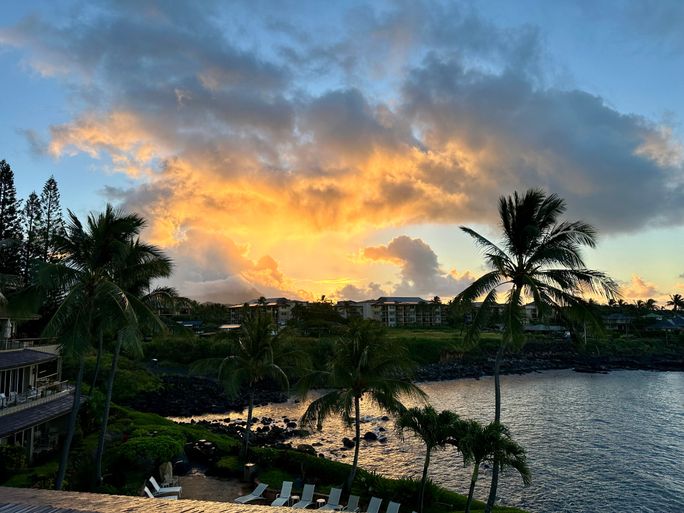
Sunrise at Whalers Cove. (Photo Credit: Scott Laird)
Much has been written about the restrictions on parking on
the North Shore, where parking permits are now limited for non-resident
motorists venturing past Hanalei Town. There's a shuttle service now that I
really wanted to try. Visitors make reservations for it in advance and park on
the grounds of the Waipa Foundation
just past Hanalei. The shuttle runs to Ha‘ena State Park, where the Kalalau
Trailhead is, and the bus driver provides some narration en route, reminding
visitors they need good shoes, plenty of water and bug spray and that hiking
past Hanakapi‘ai Falls is prohibited without an overnight camping permit.
When we reach the parking lot for Ke‘e Beach on the shuttle,
a worker again gathers everyone into a group to give reminders on how long some
of the hikes are and what time hikers should turn around if they want to make
the last shuttle back—otherwise, it's a long walk.
I’m delighted to find Ke‘e Beach much improved. The adjacent
wooded area used to be unkept and littered, and the streets leading up to the
beach were lined with cars because of insufficient parking. Today, the woods
are pristine, with clearly marked walking trails from the parking lot, which
also crosses a community taro patch. Taro is a staple in Hawaiian cooking—the
main ingredient in starchy, nutrition-rich poi.
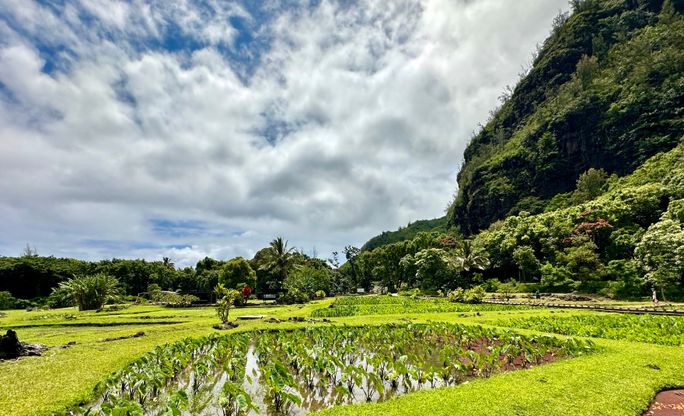
Taro Grove Near Ha'ena. (Photo Credit: Scott Laird)
Ke‘e Beach is a wonderful place to spend a day – there are
plenty of shade trees, a sugar-sand beach, and a lifeguard station. It's an
area that keeps cropping up in Hawaiian songs and stories, perhaps most
famously figuring in a tale involving the goddess Pele, her lover Lohi‘au and
her sister Hi‘iaka. Today, though, there's the constant buzz of helicopters
over the beach—perhaps one every five minutes. It's a good indicator of one of
the central tenets of the regenerative tourism plan, which discourages visitors
from visiting the Na Pali Coast by hiking the Kalalau Trail in favor of visits
by air or sea.
Kaua‘i County spends
significant resources each year rescuing hikers injured on the trail—many due
to being ill-prepared or hiking beyond their abilities. There's also the
expense associated with periodic trash removal from the path and the Kalalau
Valley. Kaua‘i Visitors Bureau strongly
encourages visitors to see the Na Pali Coast by helicopter or boat excursions.
I strongly encourage visitors to see it both ways—the Na Pali Coast is one of
those places on earth where words like “breathtaking” and “awe-inspiring” are
simply not hyperbole—there are just no better words to describe it.
Another tenet of the regenerative tourism plan is for the
island to be more food secure and less dependent on imports. Visitors can learn
about the island's bounty on a Tasting Kaua‘i food tour in downtown Lihue. This
tour helps spread some of the tourism wealth outside the resort areas without
overrunning the community. Stops include a microbrewery,
a vegan-friendly grocery store, a
gastropub, and a ginger beer shop—all far from the
tourist districts in Lihue, which—aside from the swaying palms, lava rock
historic buildings (like the gorgeous Kaua‘i Museum—another must-see in the neighborhood),
and lush mountain views, feels like any small American town.
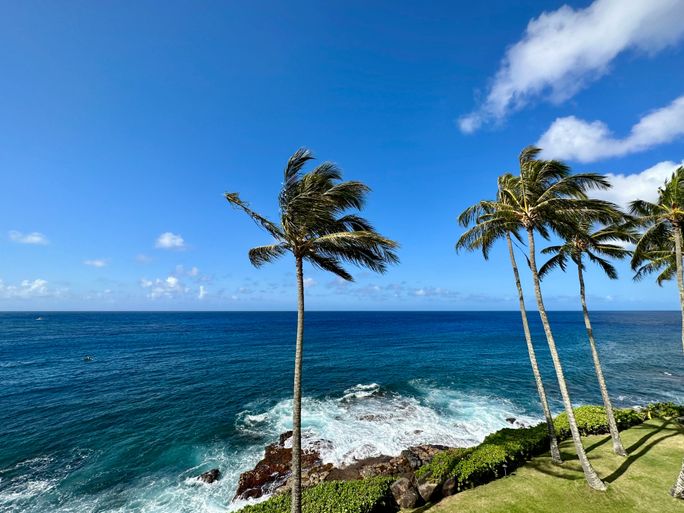
View from Whalers Cove. (Photo Credit: Scott Laird)
For more organic fare and lovely sunset views, visitors can
check out Merriman’s in
Poipu, where fish is from dayboats, and the "dirt grown" salads use
local produce whenever possible. The entire restaurant group (also located on
O‘ahu, Maui, and the Island of Hawai'i) works with GreenPlaces to reduce their
carbon footprint. Like surf and turf? Try the petite filet paired with
macadamia nut-crushed fresh catch.
For more great dining in Poipu, try Red Salt at Ko‘a Kea Resort, where
the Executive Chef is Kaua‘I Native Noelani Planas, whose culinary mentors
include Joel Robuchon and Wolfgang Puck. At Red Salt, she brings local and
imported ingredients together inventively—the seared Hokkaido scallops with local
sweet corn and Portuguese sausage ragu still live rent-free in my head.
Overall, I felt Kaua‘I had weathered the pandemic well and
is well-positioned to continue developing tourism on the Garden Island positively with its regenerative tourism plan.
The author acknowledges the significance of
Hawaiian Language diacritical marks such as the kahako (macron), but some may have
been omitted for web browser compatibility.
For the latest travel news, updates and deals, subscribe to the daily TravelPulse newsletter.
Topics From This Article to Explore


