
by Mia Taylor
Last updated: 7:00 AM ET, Sat March 23, 2024
As the impacts of climate change grow increasingly severe, more and more products and services are being marketed to travelers to help offset one’s carbon footprint.
Among the most common is carbon offsets - which allow individual travelers to invest in environmental projects designed to help lower carbon emissions pollution. Common examples of projects that can be funded with carbon offset purchases include reforestation work and construction of renewable energy sources.
While these purchases can seem helpful, there’s also a great deal of debate about whether they really have a meaningful impact in the fight to slow and reverse climate change. At their worst, carbon offset projects have been labeled a form of greenwashing that does not truly help reduce CO2 emissions. Though some experts argue that the benefits of purchasing offsets may outweigh any challenges identified by critics.
There are also other steps travelers can take to reduce carbon emissions, which some travel industry leaders say are more effective. One of the leading alternatives is investing in the next-gen approach of Direct Air Capture With Carbon Storage (DACCS) - or technology that eliminates CO2 from the atmosphere and stores it permanently.
The variety of options - not to mention their pros and cons - can be daunting for the average traveler to sift through and make sense of when planning a trip.
With that in mind, TravelPulse took a deeper dive into carbon offsets and carbon capture technology. Here’s what travelers need to know.
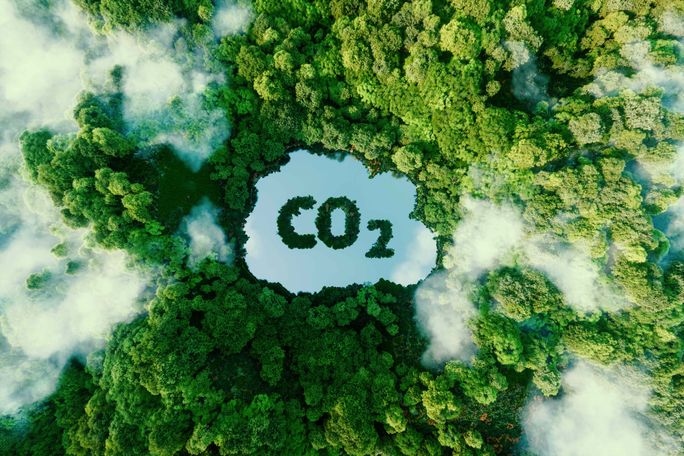
Carbon dioxide emissions and its impact on nature (Photo Credit: Courtesy AdobeStock)
Carbon offsets: How they work and the sources of criticism
Each year, planes emit more than 850 million tons of carbon dioxide, according to the Environmental Defense Fund (EDF). And that pollution is on track to triple by 2050. If it were a country, aviation would be one of the world’s top 10 emitters, says EDF.
To break that down even further, a one-way flight from San Francisco to Paris can produce about 1.25 metric tons of carbon emissions per passenger, according to the organization Sustainable Travel International. That’s more than a quarter of the amount of carbon that the average person worldwide produces per year – just from one round-trip flight.
One of the most popular products being marketed to travelers to help address this problem are carbon offsets, which theoretically offset the greenhouse gas emissions associated with a traveler’s flight. Offsets are sold by a variety of standalone companies including Sustainable Travel International, Cool Effect, and Terrapass, to name a few. It’s also possible to purchase offsets directly from some airlines and even online booking sites.
Carbon offsets can be bought in very affordable increments and the transaction takes just a few minutes online, all of which can make this approach incredibly appealing to travelers concerned about the impact of flying.
But there are wildly different opinions on whether offsets actually work. The World Wildlife Fund (WWF), for instance, says they’re not an effective resolution to the problem of carbon emissions associated with flying.
“You will have heard a lot of mention of offsetting emissions as a way of reducing your carbon footprint. Unfortunately, there has been a rise in greenwashing in this area, with schemes making misleading claims and false promises. Carbon offsetting does not reduce emissions at the source and purchasing offsets should be a last resort, after other measures to reduce or avoid emissions have been explored,” says the WWF website.
One of the primary criticisms of carbon offsetting is that there’s no way to prove whether projects being funded by offset purchases are effective or have the promised benefits.
“One of the most common offsetting schemes is tree planting. But there’s no guarantee a forest will be permanent or well-managed, or that native species will be planted in the right areas with proper consideration of nature,” explains the WWF website.
The website Carbon Brief, a UK-based platform that covers the latest developments in climate science, climate policy and energy policy, says climate offset projects may be making claims about the benefits of their projects that don’t prove true. "There is mounting evidence that offset projects, from clean-cooking initiatives to forest protection schemes, have been overstating their ability to cut emissions. One yet-to-be published study suggests that just 12 percent of offsets being sold result in ‘real emissions reductions’” says the website.
Christina Beckmann, head of Tomorrow’s Air, a collective focused on cleaning up carbon dioxide from the atmosphere, says while there is some value to carbon offsets, the impact of such projects can be hard to prove.
“Credible carbon offsets are important. They do help fund conservation in places where it’s important,” she tells TravelPulse. “These things are all true. And at the same time, they can be very hard to validate.”
A lot of times, continues Beckmann, carbon offsets are based on claims that may be less than factual such as: "If it weren’t for your spending, this forest would be cut down.”
“That kind of thing can be tricky to prove,” Beckmann points out. “And the average person is not going to be able to do a deep investigation on every project and its claims.”
Best practices for carbon offset purchasing
For travelers who want to purchase carbon offsets, there are some basic due diligence steps that can help ensure dollars spent are having maximum impact, says Scott McDougall, director of sustainability for Adventure Canada.
Third-party certification
Looking for third-party certifications when selecting carbon offset projects and companies to work with is an important first step.
“Ensuring offsets do what they’re intended to is complicated. Thankfully several excellent third-party certifiers have emerged to make the selection process easier,” explains McDougall, who recommends that travelers choose offsets certified by at least one of the following programs administered by not-for-profit organizations:
- Gold Standard
- Verified Carbon Standard
- Climate Action Reserve
- American Carbon Registry
Consider relevance
It's also a good idea to select or support offset projects that align with your travel in some way - such as opting to fund an effort that benefits the destination you plan to visit, says McDougall.
“In our case, for example, while we search to find or create projects in the Arctic, we have chosen to support the Great Bear Forest carbon offset project because it is Canadian, Indigenous-owned, and in an area we sometimes voyage,” explains McDougall. “Choosing projects that align with your values and that will have a tangible impact on the place you travel may be important to you, and if so, relevance is something critical to consider.”
Look for financial transparency
As with any purchase, make sure you understand in advance exactly how your money will be spent. In the case of carbon offsets, find out what percentage of the money you contribute will be used for its intended purpose, says Hilary Matson, founder of the sustainable travel company Yugen Earthside.
“Look for transparency about how much of your funds are going to carbon projects,” explains Matson. “This could include information on what percent of your payment is going towards the projects themselves.”
Project type matters
There are many different types of projects that can be supported by carbon offsets. Tree planting is a popular option, but can also represent a "weak effort," explains Matson “if the project doesn’t carefully ensure trees can grow to maturity, accurately report progress, and avoid the land being deforested [later]."
Other projects, such as wind and solar energy implementation, may have a more significant or long-lasting payoff, depending on the organization and the management of the project itself.

Sustainability takes many forms. (Photo Credit: narawit / Adobe Stock)
Carbon capture technology: An emerging option
When it comes to the impact of our travels, Beckmann is working to encourage a broader mindset among the public - one that encompasses not just offsetting carbon emissions, but actively removing carbon from the atmosphere through the process of direct air capture and carbon storage.
As explained in the Carbon Removal Primer and on CarbonPlan's
website, DACCS involves the
"use of chemicals to capture CO2 from ambient air and generate a concentrated stream of CO2 for storage."
In some cases the CO2 may be mixed with water and injected into basalt rock, a type of rock that underlies more of the Earth’s surface than anything else, explains Beckmann.
“This fizzy CO2 finds it’s way into the fissures of the basalt rock,” explains Beckmann. “You can think of it as cleaning up carbon dioxide from atmosphere and storing it permanently.”
These types of projects, which are taking place in countries like Iceland and Oman, offer some of the latest innovations in addressing carbon emissions and make up a large part of the work conducted by Tomorrow’s Air.
Travelers wanting to help address the impacts of their carbon footprint by supporting the development of DACCS technologies can make contributions to Tomorrow’s Air in increments as little as $10.

Airplane landing at sunset. (Photo Credit: william87/Adobe Stock)
Demand more from travel providers
Between trains, planes, automobiles, tours, hotels, currencies, and restaurants travel is complicated. When you add carbon quantification and offsetting into the mix, it can be a headache for the average individual.
To that end, all the experts interviewed said the best long-term solution is for travel providers to step up and incorporate such carbon offsetting into their business models. Some industry leaders are already doing that, but they remain in the minority. Travelers can help pressure more providers to do their part - whether it's an airline, a travel advisor or a hotel - calling upon such companies to actively solve the carbon offset problem for customers, says McDougall.
“Not only does this make the offsetting a breeze, it tells the industry that they need to anticipate and provide this for guests,” McDougall explains.
Beckmann offers similar insight, suggesting that it’s not realistic to expect travelers to do all the legwork when it comes to supporting carbon offsets or carbon capture efforts. And only when the travel industry begins to move in the direction of incorporating these types of expenses into their booking or pricing models, will we experience the sea change that’s so desperately required at this juncture.
“On the grand scale, these things should all become embedded in the cost of travel, in the same way a banana in the grocery store is inappropriately expensive in order to accommodate for cost of shipping it,” says Beckmann.
Whether it comes from the consumer or the industry itself - or some combination of both - these types of carbon offsetting, capture and storage efforts have never been more critical, Beckmann adds.
“If all emissions stopped today, we’re still on a warming trend for the next 1,000 years,” says Beckmann. “We waited too long to reduce our emissions. Nature can’t do this job alone anymore.”
For the latest travel news, updates and deals, subscribe to the daily TravelPulse newsletter.
Topics From This Article to Explore


