
by Mia Taylor
Last updated: 7:00 AM ET, Thu September 10, 2026
It almost seems hard to believe that a quarter century has passed since 19 al-Qaeda terrorists hijacked four commercial airplanes and engaged in a coordinated suicide attack on the United States.
On that fateful day, hijackers flew American Airlines Flight 11 into the North Tower of the World Trade Center and United Airlines Flight 175 into the South Tower, killing 2,606 people.
Separately, a third plane, American Airlines Flight 77, was flown into the headquarters of the U.S. Department of Defense, while the fourth, United Flight 93, crashed into a rural field as heroic passengers and crew fought back against hijackers, preventing the plane from hitting its intended target.
The hijackers had used small knives to threaten passengers, attack crew members and seize the planes. The result was the most lethal and consequential act of terrorism in U.S. history: 2,977 people perished on September 11, 2001.
I remember the events of that day vividly. I was in my apartment in Boston, getting ready to start my workday at a local newspaper, and I had the television on in the background. On the screen, I saw images of black smoke billowing from a giant gash in one of the Twin Towers and thought perhaps the latest Arnold Schwarzenegger movie was playing.
It wasn’t until I stopped and listened to the commentary from a news anchor that I understood how wrong I was. And then, as the towers crumbled to the ground in a cloud of smoke, the terror of what was actually unfolding sent chills down my spine.
For the next few hours, I sat glued to the TV trying to wrap my mind around the events playing out before me and the horror of it all. I also soon learned that my planned flight to Greece the next day would, of course, not happen.
As the reality of what was taking place became clear to the U.S. government, the Federal Aviation Administration ordered a complete closure of airspace to prevent any further acts of terrorism from taking place. By 9:45 a.m. on September 11, a national ground stop was in place with only rare exceptions for critical emergency or military flights.
From that point forward, travel as we know it changed, in ways both big and small.
“The immediate impact was enormous. Beyond the devastating human loss, the attacks shattered a basic assumption about commercial aviation,” says Brian Rooney, a travel advisor and founder of GetCruiseInfo.com. “An airplane was no longer viewed simply as something that could be hijacked to transport people somewhere else. It had been demonstrated that an aircraft itself could be used as a weapon.”
The realization that planes themselves were now being used as deadly weapons, Rooney says, upended the security equation around travel almost overnight.
Here’s a closer look at how travel evolved in the days, weeks and months after 9-11 and where things stand today, 25 years after the deadliest and most significant terror attack on U.S. soil.
Closing security gaps in the wake of 9/11
On November 19, 2001, 69 days after the 9/11 attacks, the United States government established the Transportation Security Administration (TSA) when George W. Bush signed the Aviation and Transportation Security Act into law.
The agency was created to address the major gaps in airport security that were laid bare by the deadly 9/11 attacks. In an article recently published by Metropolitan State University, Denver, instructor and aviation security expert Jeff Price from the Department of Aviation and Aerospace Science describes TSA’s creation as the single biggest change to the industry.
“The government stood up a 50,000-plus-person organization in the span of a year and took over screening at U.S. airports from the airlines and their contractors,” Price explains, adding that TSA fundamentally altered how aviation security was managed, moving responsibility away from airlines and establishing national standards for screening and oversight.
At the same time, airlines immediately began “hardening aircraft” and tightening security protocols, Greg Pearson, founder and CEO of the travel risk management company FocusPoint International, told TravelPulse.
“The most visible example of aircraft hardening following the attacks on 9/11 was the modifications made to the cockpit doors, using composite and bulletproof materials,” explained Pearson. One less well-known measure, meanwhile, was the Federal Flight Deck Officer Program. “This allowed qualified flight crew members authorization from the newly formed Department of Homeland Security to carry firearms inside the cockpit for defense purposes,” Pearson added.
Another major development that emerged after 9/11 was mandatory baggage screening. Before 9/11, only a small percentage of checked luggage underwent security checks. After the attacks, 100% of baggage began being screened for explosives.
And in perhaps the most noticeable evolution for travelers, passenger security screening expanded significantly to include everything from metal detectors to full-body scanners, along with strict limits on what passengers could bring on a plane.
In particular, the FAA banned knives and box cutters from carry-on bags. It also immediately restricted gate access at airports to ticketed passengers only.
“In the years following 9/11, people were not accustomed to increased screening, random pat-downs and sniffs of luggage, and certainly weren't yet accustomed to things like body scanners or removing shoes and other accessories,” Geoff Kohl, a former security industry journalist, told TravelPulse.
“There’s no way to sugarcoat it. It was a challenging time in terms of the required changes,” added Kohl, now a senior director of marketing at the Security Industry Association (SIA), a Washington, D.C.-area trade group that represents security technology firms. “But I think we all look back on it and say, yes, that had to be done.”
Long-term travel industry changes
The airport security screening process that travelers continue to pass through to board a flight in the United States is perhaps the most visible and enduring legacy of the events of 9/11. But it is hardly the only lasting example of how the travel experience has been altered.
“In many ways travelers encounter its legacy every time they walk into an airport,” says Rooney. “The security checkpoint, restrictions on what passengers can carry aboard, reinforced cockpit security, passenger vetting and many of the procedures travelers consider routine today grew out of the reassessment of aviation security that followed September 11.”
The deeper change, adds Rooney, is the industry’s overall approach to risk. Travel companies, airports and governments have to think about security proactively rather than simply responding to what has happened before.“Security planning increasingly involves asking, ‘What could happen next?’” Rooney says.
Security procedures continue to evolve as technology and threats change, but the underlying principle remains: Security can’t simply assume that tomorrow’s threat will look like yesterday’s.
That mindset extends well beyond aviation, Rooney added. Cruise lines, hotels, tour operators and destinations all operate in an environment where security, emergency planning and communication with travelers are far more important considerations than they were decades ago.
What’s more, some of the security measures and recommendations born out of the heightened awareness triggered by 9/11 are still taking shape or are only just beginning to influence the travel process as we know it.
“There are some reports that say some of the recommendations that came from 9/11 still haven't been fully implemented, like a biometric entry-exit program,” says Kohl. “So, 25 years later, we're still making gradual improvements to the security of travel.”
Meanwhile, other measures adopted after 9/11 are being undone or are under scrutiny and pressure from new presidential administrations. TSA, for instance, has faced criticism and operational challenges over the years. Under the Trump Administration, there have been increased efforts to privatize airport security screening services, which may or may not be for the best.
“The recent push to move to more privatized operations has come from politicians. And it runs the gamut: from abolishing the TSA organization — which I think would be a significant step backward and allow numerous 9/11 level events to occur — to expanding [private security at] hundreds of small airports,” Price, the MSU Denver professor, has said.
While it remains to be seen what the future holds, Price has said he believes that the shift to a federal takeover of airport screening with TSA in the aftermath of 9/11 was critical to safe travel, pointing out that: “As long as security was an airline expense item, they were not going to spend any more money than necessary to meet regulatory requirements.”
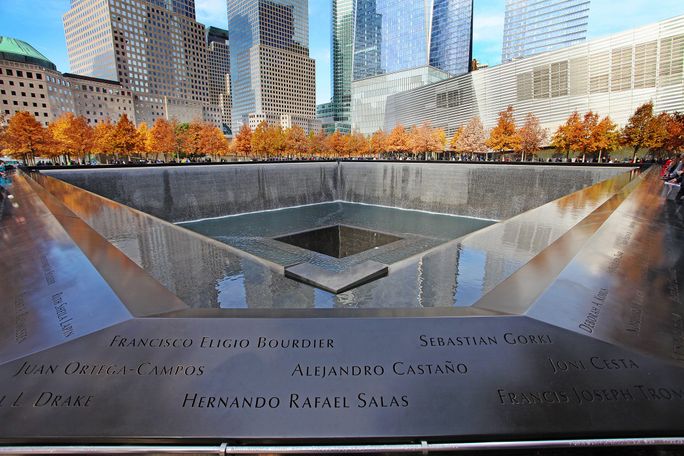
September 11 Memorial & Museum, New York City. (photo courtesy of Collette) (Photo Credit: Provided by Collette)
Altered mindset of American travelers
A discussion about the events of September 11, 2001 would hardly be complete without touching upon how that devastating day impacted life for scores of people.
Fathers, mothers, brothers, sisters, co-workers, and friends said their goodbyes that day to loved ones who would never return. Families' lives were forever changed. Manhattan’s skyline was dramatically altered. And the sense of security that many Americans felt in their own country, not to mention when traveling on commercial airplanes, was upended in ways that previously seemed unimaginable.
Among Americans who lived through the events of 9-11 and understood the full scope of the national wound it inflicted, there is now an ever-present awareness that things have the potential to go terribly wrong when traveling. “The line between anxiety and awareness will be forever blurred, it seems,” said Pearson. “At least for those of us who witnessed, or worse yet, were directly impacted by the tragic events of September 11, 2001.”
Yet, more than 100 million Americans have been born since 9-11. Meaning nearly one-third of the current U.S. population did not bear witness to the terrorist attacks or watch the Twin Towers collapse into a pile of rubble in real time. They did not watch the grim search for survivors play out at Ground Zero or the subsequent effort to recover human remains as the massive pile of rubble and debris was cleared. Instead, these Americans learned about the tragedy in school and through documentaries in much the same way previous generations were taught about World War II or the attack on Pearl Harbor.
For these people, the changes to the travel process brought about by 9/11 have always been a standard part of the experience. Travelers today expect to show identification, go through security screening, remove prohibited items from their bags and arrive at airports well before departure. For younger travelers, there really isn’t a memory of commercial aviation operating any other way.
Yet no matter when you were born or what you did, or did not witness, the lessons of 9/11 remain the same and should not be overlooked, say experts. “However material and inconvenient the changes in travel may be, just know that they were and continue to be necessary to mitigate against anything like 9/11 ever happening again,” said Pearson.
As for those of us who did live through 9-11, perhaps Kohl’s insights best capture how that day 25 years ago continues to reverberate in our hearts and minds.
“It's hard to underscore how pivotal a moment it was for Americans and the world,” said Kohl. “It's a timestamp on our lives. There are very few things you can precisely recall as you look back on your life, but this moment when the Twin Towers were attacked was something that all of us in that generation will never forget.”
For the latest travel news, updates and deals, subscribe to the daily TravelPulse newsletter.
Topics From This Article to Explore


