Newly released Federal
Aviation Administration (FAA) figures reveal that, despite a significant
uptick in hiring last year, the nation's air traffic control stations remain
approximately 3,000 controllers short.
These disappointing
numbers underscore the ongoing challenge of solving the staffing shortage,
which has led to the past few years’ worth of flight delays, as well as safety
concerns that multiple near-collisions on runways were attributable
to controller fatigue. The worker deficiency is a source of unease among
airlines, controllers and regulatory agencies—including the inspector general, who
last summer criticized the FAA for making, “limited efforts to ensure adequate
controller staffing at critical air traffic control facilities.”
Currently the
number of controllers who are either fully certified or capable of working on
their own at the ‘Certified Professional Controller In Training’ stage is
around 11,500. However, staffing plans put forth by both the FAA and the air
traffic controllers' union are aiming for a total of over 14,600 controllers in
order to fully staff the nation’s air traffic control towers and centers. These
figures pertain to the fiscal year ending in September 2023 and do not include
employees in developmental stages or those undergoing training at the FAA's
academy.
Despite hiring
1,512 new controller candidates last year, slightly surpassing the agency's
goal of 1,500, the FAA also lost almost as many controllers, with roughly 1,300
employees leaving, including retirees and trainees who dropped out.
Approximately 400 individuals failed out of the FAA's academy, while another
109 who were further along in the process decided to withdraw from training. Altogether,
2023’s hiring round resulted in a net gain of around 160 workers, which represented
at least a modest increase compared to the previous hiring cycle, which netted
only six new workers.
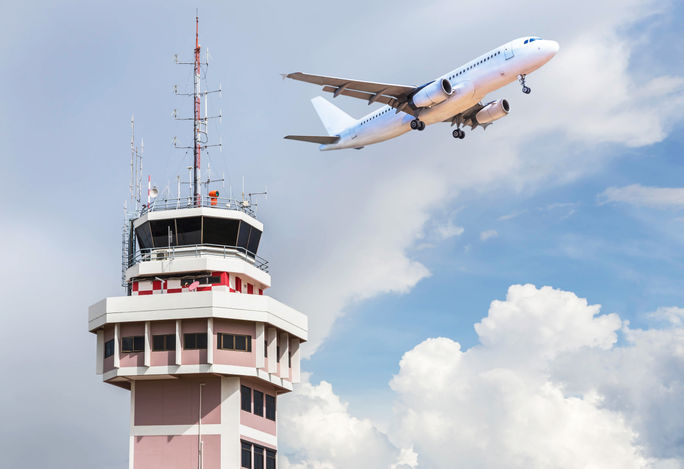
Air traffic control tower with an airplane taking off in the foreground. (Photo Credit: Adobe Stock/Soonthorn)
To address the
ongoing shortage, the FAA aims to hire 1,800 controllers in the current fiscal
year, ending in September. The trade organization that represents major U.S. passenger
carriers, Airlines for America (A4A) opined that the FAA’s system of, “hiring
and training is fundamentally broken if it takes this long to hire and train
controllers.”
“We are
particularly concerned as our carriers have been working diligently to meet
record summer travel in the coming weeks, and carriers have had to cut back
their schedules in congested areas to accommodate the ATC shortage at the
expense of travelers who are seeing fewer flight options in those markets,” A4A
said in a statement given to CNN.
The FAA
and NTSB Reauthorization Bill, which has just been approved by the Senate
and passed onto the House, mandates that the FAA ramp up hiring over the next five-year
period. Furthermore, it requires the installation of additional simulators at
air traffic control sites to the expedite training process.
Meanwhile, the
existing short-staffed situation forces controllers at busy facilities to
regularly work overtime. Concerns about air traffic controller fatigue contributing
to a spate of recent safety incidents recently prompted FAA Administrator Mike
Whitaker to increase
personnel rest standards to a minimum of 10 to 12 hours between shifts.
For the latest travel news, updates and deals, subscribe to the daily TravelPulse newsletter.
Topics From This Article to Explore


