Air turbulence on board
a flight can range from being just a mild nuisance to a genuine safety threat for
anyone who isn’t properly buckled into their seat. For some flyers, it’s a matter
of course that some turbulence should occur in mid-air, while the experience
strikes genuine terror into the hearts of others. Of course, the intensity of
the phenomenon plays quite a large role in how it is perceived by passengers.
Now, thanks to a
new report from online travel
tool Turbli, travelers can prepare themselves mentally for what they might
expect to encounter on their next flight. As stated on its website, Turbli’s “goal
is to provide flight travelers with the most accurate turbulence forecast”. The data is uses is taken directly from the National Oceanic and Atmospheric Association (NOAA)
and National Weather Service (NWS).
As defined by the Federal Aviation
Administration, “Turbulence is air movement created by atmospheric
pressure, jet streams, air around mountains, cold or warm weather fronts or
thunderstorms. It can be unexpected and can happen when the sky appears to be
clear. Turbulence can give an airplane a sudden jolt that can injure passengers
and flight crewmembers who aren't buckled in.” For those with a fear of
flying, the rough movement in the skies only amplifies feelings of anxiety.
This new report
uses Turbli’s historical database to analyze 150,000 airline routes and rank them
according to average turbulence levels, producing a list of which routes
passengers are most likely to experience a bumpy ride. For the report, overall turbulence
levels were determined by assigning each route an "eddy dissipation rate",
which is a scientific measure of turbulence intensity, according to
Travel
+ Leisure.
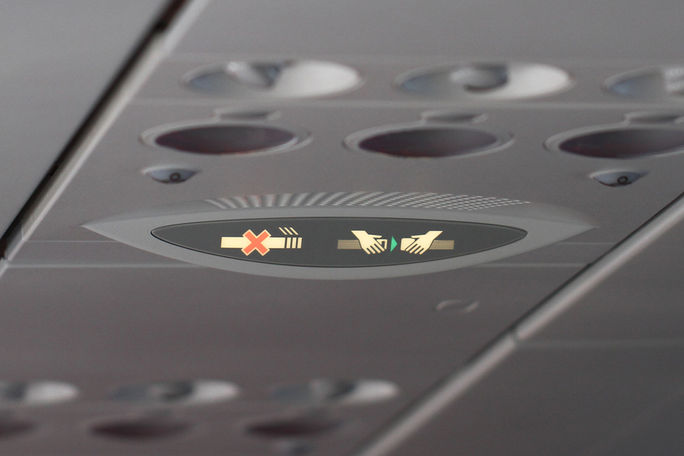
PHOTO: Airline cabin no-smoking and fasten-seatbelt safety lights. (Photo via Biggereye / iStock / Getty Images Plus)
For each flight,
the turbulence is computed over a geodesic and at its average cruising altitude.
For flights in the United States, multiple routes to Raleigh/Durham, New
York City and Boston
top the list of those most likely to experience in-air turbulence. So, be sure
to buckle up!
Here are the 10
most turbulent routes in the U.S.:
- Nashville (BNA) to Raleigh/Durham
(RDU)
- Charlotte (CLT) to Pittsburgh (PIT)
- Denver (DEN) to Puerto Vallarta (PVR)
- New York City (JFK) to Raleigh/Durham
(RDU)
- Warwick (PVD) to Syracuse (SYR)
- Atlanta (ATL) to Dulles (IAD)
- Pittsburgh (PIT) to Raleigh/Durham
(RDU)
- New York City (LGA) to Portland (PWM)
- Boston (BOS) to Syracuse (SYR)
- Boston (BOS) to Philadelphia (PHL)
The report also
identifies those global airports that are most likely to experience turbulence within
100 kilometers of the hub, with Santiago, Chile
(SCL), Medina, Saudi
Arabia (MED), and Tokyo, Japan's
Narita (NRT) topping the list. Denver (DEN) is the only U.S. airport in the
global top ten, ranking seventh.
Serious injuries
from turbulence have seen an uptick in recent years, with 17 reported cases in
2022, marking the highest level since 2011. Most injuries occur among airline
crew members, according to FAA data, which only makes sense, given that they’re
walking around the cabin. To prevent injuries, the FAA recommends keeping
seatbelts fastened at all times and using approved child safety seats onboard
aircraft.
Despite the
discomfort turbulence may cause, experts reassure travelers that modern
airplanes can withstand major turbulence without sustaining damage. As
travelers embark on flights, awareness and adherence to safety guidelines
remain crucial for a smooth and secure journey.
For the latest travel news, updates and deals, subscribe to the daily TravelPulse newsletter.
Topics From This Article to Explore


