The United
Kingdom (UK) continues to be a top destination for American travelers, but
if you’re planning on soaking in some of the country’s incredible dramatic
coastlines and picturesque beaches while you’re there on holiday, a word of
warning—you may find yourself swimming in sewage if you aren’t careful.
According
to CNN,
the past few years have seen the UK’s problem of effluent-filled beaches worsening
after the news of raw sewage overflows caused a national scandal in 2022. The
problem can be traced to the country’s system of “storm overflows”, which dump
the contents of overly full drains into rivers and seas, and are supposed to be
activated only in exceptional circumstances.
But,
since 2021, these events have become all too common, creating water quality problems
on a truly shocking scale. In the intervening years, Britons have too often
seen beaches closed during peak summer weekends or found themselves swimming in
poopy waters, as well as witnessing dead marine life floating in their busy
rivers.
The Sewage Situation
In
2021 alone, the data indicated that the UK’s storm overflows across the nation belched
out contaminated wastewater for a combined 2.7 million hours, which translates
to over 300 years. And it has only gotten worse since then, sparking outrage
among the British public in 2022 when the problem was brought to public attention.
A
bank holiday weekend in August 2022—a time when Brits typically head to the
beaches—saw a beach that’s popular among Londoners in Brighton and Hove closed
down due to the spillage. “Brighton and Hove seem to be deluged over and over
again,” Hugo Tagholm, former CEO of the marine conservation charity Surfers
Against Sewage, told CNN at the time.
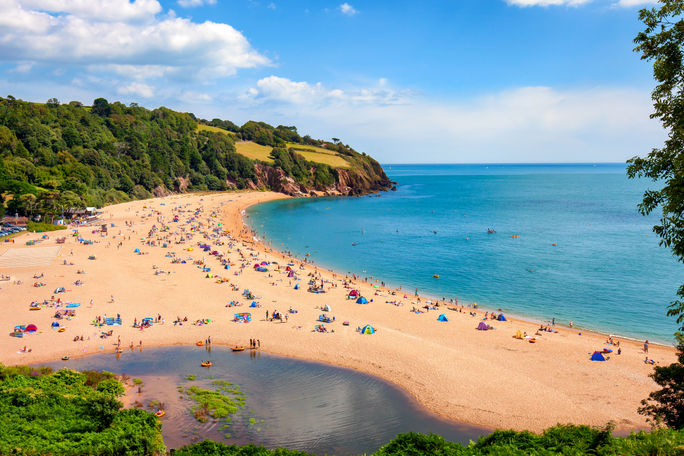
People enjoying the Blackpool Sands beach near Dartmouth in Devon, England. (Photo Credit: Adobe Stock/Matthew)
This
weekend the public celebrates another bank holiday in Britain and, while Brighton
and Hove beaches are safe for swimming, many others around the island nation
aren’t. In fact, Surfers Against Sewage’s live tracker tool indicates that 12
out of 14 storm overflows located on the Isle of Wight (a popular escape among
vacationers) are presently spewing sewage. Overflows are also operating in Devon,
also a well-attended getaway spot, including one on Sandy Bay—a beach that had
previously been awarded Blue Flag status for its unspoiled waters.
According
to the annual “Event Duration Monitoring” (EDM) report on storm overflows,
released in March by the UK government’s Environment Agency, sewage spills
increased in 2023 by an astounding 54 percent. The average number of spills per
overflow in a single year had increased from 23 in 2022 to 33 in 2023, which is
more than one every couple of weeks. The total number of spills rose from 301,091 to 464,056.
And,
it isn’t just the number of spills that’s increased. Raw sewage was disgorged
into UK rivers, seas and beaches for double the amount of time in 2023 than during
the previous year—a cumulative total of 3.6 million hours, equivalent to over 400 years.
The
number of “well-behaved” overflows went down, as well. While, in 2022, 48
percent spilled their contents fewer than 10 times a year, in 2023, that figure
dropped to 40 percent. The proportion that didn’t spill at all fell from 18
percent to less than 14 percent.
“It’s
a total scandal,” Giles Bristow, current CEO of campaign group Surfers
Against Sewage, told CNN. “Things have got massively worse – it’s a shocker.”
He blames “massive underinvestment by private water companies who’ve failed to
do their duty” for the ever-increasing poopy water problems.
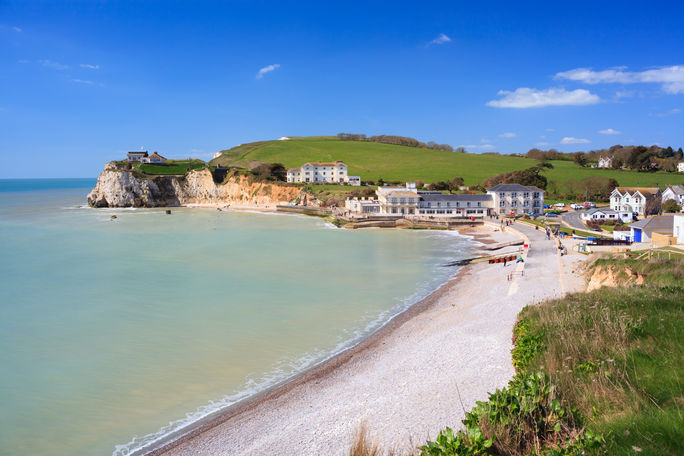
Freshwater Bay on the Isle of Wight, England, UK. (Photo Credit: Adobe Stock/Ian Woolcock)
The Current Outlook
Bristow, who surfs
and swims in UK waters himself, advises that anyone looking to do so download the
real-time Safer Seas & Rivers Service’s water quality tracking app or consult the real-time map on its
website before taking a plunge.
Surfers Against Sewage is campaigning the British
government to find a way to stop this spillage into bathing water and
high-priority nature sites by the year 2030. In 2023, the government installed monitors on all the of
country’s storm overflows, so that accurate data can be harvested from them.
And, the government’s “Storm overflows discharge reduction plan”, which was
introduced in 2022, has set targets for privatized water companies to “reduce
the impact of storm overflows” by 2050.
“It’ll
take time to turn the tank around, but the tide is turning,” Bristow said. “We
should expect to see things turn around by 2030 if we’re making the right
investment decisions now. The time to act is now or never.”
In
the meantime, visitors can feel free to vacation on Britain’s beaches when they’re
open and venture out into the water where it’s deemed safe. “We have some of
the most beautiful beaches in the world, and hospitable communities,” he says.
“Come and surf, enjoy our beaches and our breaks. But download the app, and
know where to go in.”
For the latest travel news, updates and deals, subscribe to the daily TravelPulse newsletter.
Topics From This Article to Explore


