According to KultureCity, 25 percent of Americans
have an invisible disability or special sensory need, such as autism spectrum
disorder, attention-deficit disorder or dyslexia.
Now, in a groundbreaking
effort to better understand and cater to the needs of neurodivergent travelers,
Hyatt has partnered with this leading nonprofit—as well as two external
consultants, Professors Dr. Recep “Richie” Karaburun and Dr. Vanja Bogicevic
from New York University’s Jonathan M. Tisch Center of Hospitality—to conduct a
comprehensive survey to inform research-supported action.
Given that over 90
percent of neurodivergent people within the U.S. and caregivers of the same plan
on traveling at least one night in 2024, Hyatt intends to use its findings to provide
valuable insights into the challenges faced by neurodivergent travelers and
raise awareness of this growing demographic, as well as and identify key areas
where the hospitality industry can improve to create a more inclusive and welcoming
experience for them.
Stress-Free Hotel Stays Start at the Booking Stage
Nearly 50 percent
of neurodivergent travelers expressed a willingness to report their
neurodiversity amid the booking process if it would help their hotel provide
them with customized care. Among neurodivergent business travelers, the
proportion was even higher at 75 percent, while 70 percent of caregivers said
the same.
This highlights
the need for hotels to provide ready openings for self-disclosure, and to train
their staff to better understand and accommodate the needs of neurodivergent
guests. Hyatt already promotes such skills training and offers courses for its
staff members on this topic, and has committed to expanding those programs to
more properties this year.
Accurate Visuals Help Prepare Travelers for What to Expect
Visual
aids were also identified as a valuable tool for preparing neurodivergent
travelers to acclimate to their hotel stays. More than 50 percent of
respondents expressed a desire for more property visual layouts, such as 3D
virtual tours and floorplans, to help them navigate unfamiliar environments
more easily.
To
make the travel experience as stress-free as possible, hotels can start by
providing useful visuals on property websites. Hyatt exceeds the industry
standard by supplying 3D room tours and common space images on hotel websites
to help neurodivergent travelers acquaint themselves with their surroundings.
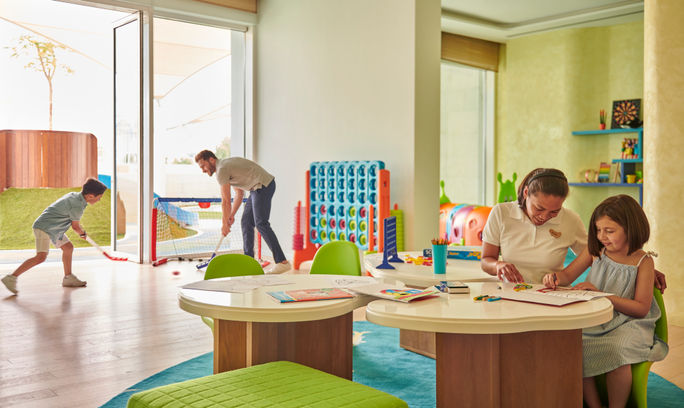
Sensory-inclusive Camp Hyatt at Hyatt Regency Aqaba Ayla, Aquaba, Jordan. (Photo Credit: Hyatt)
Accommodating Room Location and Type is Important
Over
60 percent of caregivers indicated that pre-assigning guest rooms would improve
the check-in experience, while neurodivergent travelers and caregivers both advocate
for the ability to choose rooms that best accommodate individual needs. Many
also requested that hotels remain as flexible as possible, as travelers may
discover their needs change upon arriving in the new environment.
Hyatt
will respond by allowing guests to request not only a room type, but also the
location of the room, and clearly outlining amenities on hotel websites. The company
will also be refreshing its digital products, such as mobile apps and websites,
in 2024 to increase accessibility. It is focused on adopting an even more
user-centric design and user-testing the new developments to guarantee a
seamless digital experience for everyone.
Personalized Pre-Arrival Communications Provide a Sense of Comfort
When it comes to
their pre-arrival communication preferences, both neurodivergent travelers and caregivers
pointed to email as their method of choice, but 30 percent of neurodivergent
individuals also said they’d like to receive a phone call about an upcoming
stay. Among neurodivergent business travelers, over 50 percent even said that
they’d opt to a phone call over email communications.
Hotels can incorporate
this feedback by training on-property reservations and concierge staff to
provide personalized pre-arrival communications. Hyatt already offers guest assistance
via phone, chat or social media platforms. For online inquiries on Hyatt
websites, users can launch a live chat for “Accessible Travel Assistance”. Hyatt’s
Global Property & Guest Services (GPGS) team approaches guest relations
with care and empathy to help anticipate guests’ needs and enhance their stay
with more personalized service.
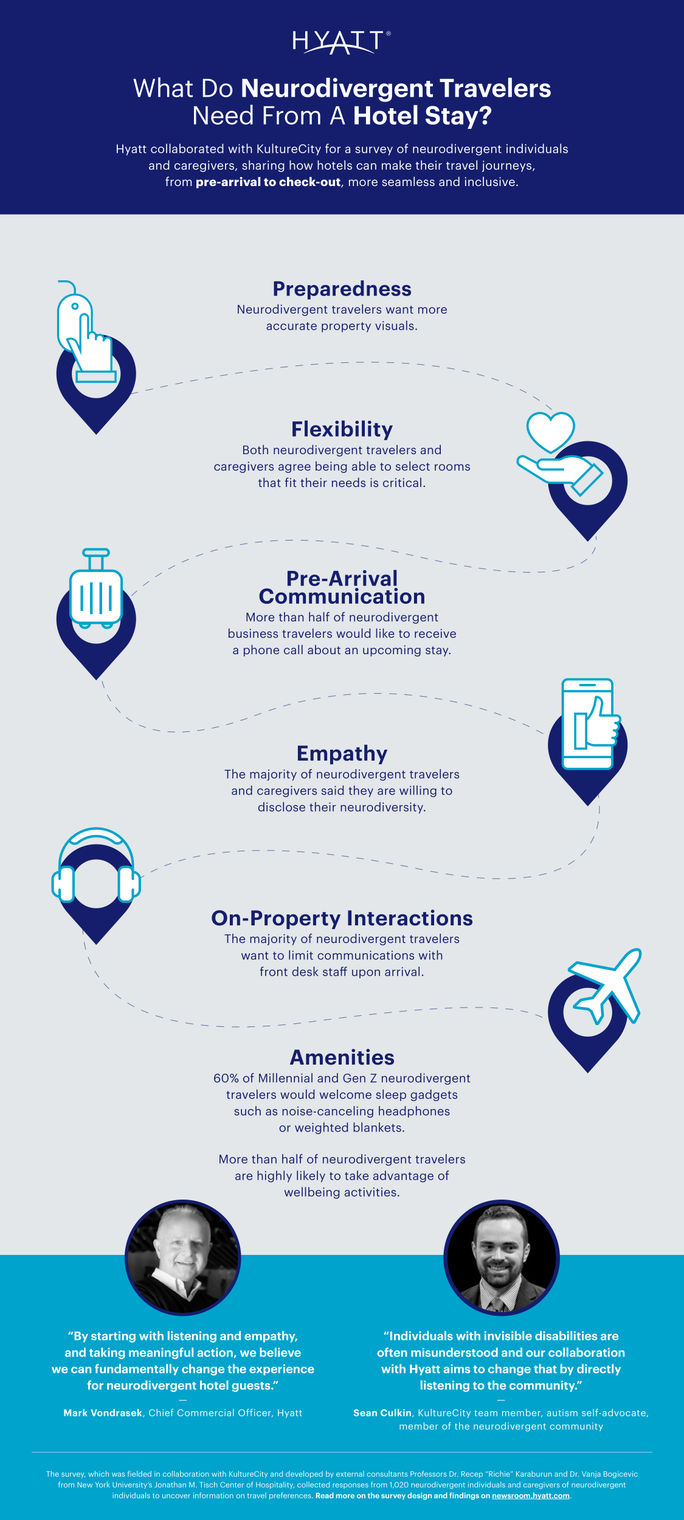
Hyatt neurodiversity survey results infographic. (Photo Credit: Hyatt)
On-Property Accommodations and Amenities Make a Difference
Digital
check-in/check-out experiences help limit on-property interactions:
The survey also
revealed that over half of neurodivergent travelers prefer to limit their
in-person interactions upon arrival at their hotel and they, as well as caregivers,
favor self-check-in options for less time spent in the lobby. Neurodivergent
business travelers particularly fancy a self or mobile checkout experience,
although all groups indicated they felt it would greatly improve their
experience.
Many Hyatt hotels
already offer digital room keys and room keys in Apple Wallet, as well as streamlined
checkout options through the World of Hyatt app.
In-room sleep
offerings and wellbeing spaces increase comfort:
Roughly 60 percent
of Millennial and Gen Z neurodivergent travelers and caregivers indicated a
desire for “sleep gadgets”, such as sleep masks, noise-canceling headphones,
meditation/sound machines, etc., as these would make their stays more
comfortable. Over 50 percent of neurodivergent travelers also reported that
they’d be highly likely to engage in wellbeing activities at their hotel, highlighting
the necessity of providing options and spaces for practicing self-care away
from home.
Hyatt currently
offers a variety of ways for all guests to relax and unwind during their stays,
having recently expanded its collaboration with the Headspace app, which
provides colored noise content to promote better rest among users. Some
properties also offer rooms that are specially designed to help guests get the
best rest possible, which feature such amenities as sleeping masks, a pillow
menu, AI-powered beds and more. Plus, the ‘Hyatt Has It’ program can provide a
variety of household essentials for guests to borrow— including headphones,
humidifiers, yoga mats and more—and, at certain properties, such expanded offerings
as sensory aids and weighted blankets.
“When someone
walks through our doors, as a colleague, guest or customer, we want them to
feel cared for so that they can be their best; this is our purpose as a
company, and our work with KultureCity and the NYU professors is a realization
of that care,” said Mark Vondrasek, Chief Commercial Officer, Hyatt. “By
starting with listening and empathy, and taking meaningful action, we
believe we can fundamentally change the experience for neurodivergent guests,
who are expecting more from their travel experiences and the hospitality brands
they choose to stay with. As we are learning more, we will work closely with
the Hyatt disABILITIES Diversity Business Resource Group and our expert
collaborators to advise us on how to make improvements throughout the guest
journey to be more inclusive.”
For the latest travel news, updates and deals, subscribe to the daily TravelPulse newsletter.
Topics From This Article to Explore


