Supersonic commercial air travel is looking more and more realistic by the day.
Just last month, Boom Supersonic's XB-1 broke the sound barrier during a test flight over the Mojave, marking the first human-piloted civil supersonic flight since Concorde's retirement more than 20 years ago.
The flight reached an altitude of 35,290 feet before accelerating to Mach 1.122 or approximately 750 mph.
The ambitious test program is setting the stage for Overture, which is expected to carry 64-80 passengers at Mach 1.7 or about twice the speed of today's airliners on more than 600 global routes.
Airlines including American, United and Japan Airlines have already placed dozens of orders and preorders for the supersonic aircraft.
However, like anything, there are pros and cons to supersonic air travel.
How Fast Will Supersonic Travel Be?
The biggest pro to supersonic travel is getting passengers to their destination faster than before.
According to Boom Supersonic, its Boomless Cruise feature based on well-established physics known as Mach cutoff enables Overture to fly at speeds up to Mach 1.3 without an audible boom. This would reduce U.S. coast-to-coast flight times by up to 90 minutes.
To meet regulations, Boom is planning to operate Overture at Mach 0.94 over land, which is approximately 20 percent faster than today's subsonic jets. However, it would gain speed over water where it would double its speed up to Mach 1.7 or about 1,300 mph.
"This confirms what we've long believed: supersonic travel can be affordable, sustainable and friendly to those onboard and on the ground," said Blake Scholl, Founder and CEO of Boom Supersonic.
How Much Will Supersonic Travel Cost?
Flying at supersonic speeds won't come cheap, at least not at first.
In the past, Scholl said that tickets for a flight from New York to London could cost travelers around $5,000 roundtrip, which is significantly more expensive than today's economy seat.
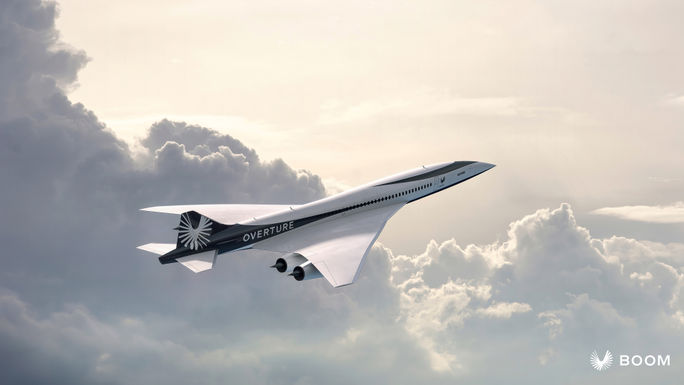
Rendering of Boom Supersonic's Overture airliner. (Photo Credit: Boom Supersonic)
How Safe Is Supersonic Travel?
According to Boom Supersonic, XB-1 has already completed a rigorous series of human-piloted test flights under increasingly challenging conditions while maintaining safety as top priority.
Features like an augmented reality vision system and digitally-optimized aerodynamics are designed with safety in mind.
"XB-1 and Overture both have a long nose and a high angle of attack for takeoff and landing, which makes it difficult for pilots to see the runway in front of them," according to Boom Supersonic. "Both aircraft leverage an augmented reality vision system to enable excellent runway visibility—without the weight and complexity of a moveable nose like Concorde's."
"Engineers used computational fluid dynamics (CFD) simulations to explore thousands of designs for XB-1. The result is an optimized design that combines safe and stable operation at takeoff and landing with efficiency at supersonic speeds. CFD is also used extensively in the Overture program," the company adds.
Will Supersonic Travel Be Sustainable?
Boom Supersonic is considering the environment as its supersonic aircraft are designed to run on 100 percent sustainable aviation fuel (SAF).
While travelers will have to remain patient when it comes to supersonic air travel it's apparent that the pros outweigh the cons. Getting around the world faster than ever before will come with a hefty price tag in the beginning but passengers stand to save significant time while enjoying a unique yet sustainable and safe air travel experience.
For the latest travel news, updates and deals, subscribe to the daily TravelPulse newsletter.
Topics From This Article to Explore


