
by Mia Taylor
Last updated: 6:25 PM ET, Tue May 19, 2026
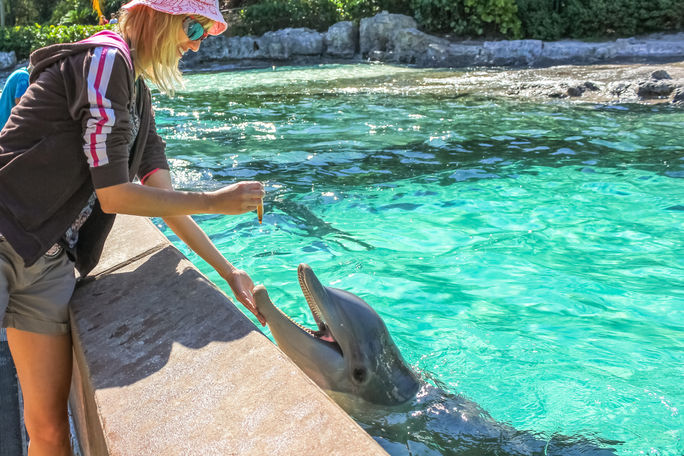
Woman feeding a dolphin. (Photo Credit: Adobe/bennymarty)
Disney’s popular Aulani resort in Hawaii and Hawks Cay Resort in Duck Key, Florida, have both confirmed that they are no longer offering captive dolphin encounters.
According to a press release issued today by PETA, the resorts have removed the controversial activities from their guest offerings.
Aulani has apparently removed captive dolphin encounters from the resort’s website, according to PETA. The experience, previously listed by the resort, involved an off-site excursion to a “swim with dolphins” experience at Sea Life Park—a Waimānalo marine park with a long history of what PETA described as “animal suffering and death.”
The move at the Aulani resort follows parent company Walt Disney’s decision to remove dolphins from The Seas with Nemo & Friends pavilion at EPCOT in 2024.
Hawks Cay Resort—previously home to a “swim with dolphins” attraction owned by the parent company of the troubled and now-defunct Miami Seaquarium (where multiple dolphins died in captivity) —confirmed to PETA that it will be charting a different course following the program’s closure.
“Dolphins belong in the open ocean where they can swim freely and live with their families, not imprisoned,” PETA President Tracy Reiman said in a statement.
“PETA is celebrating this compassionate move by Aulani and Hawks Cay and reminds travelers to do their part by leaving animal-exploiting activities off their itineraries,” Reiman added.
While most people have good intentions when they go on excursions or visit parks that allow for swimming with dolphins, there are many reasons to avoid such offerings.
As PETA notes, the dolphins used in these programs are sometimes illegally captured and sold to parks around the world. Many have been torn away from their families and ocean homes, while other dolphins are used as breeding machines to create more animals that will live and suffer confinement.
What's more, when they live in nature, dolphins choose their own partners, swim up to 60 miles a day, and form long-lasting friendships within their pods. Dolphins that are subjected to a life in captivity, including for hands-on encounters with tourists, are confined to barren concrete tanks or shallow, makeshift lagoons and are often forced into incompatible social groups, PETA explained.
There is also a long history of dolphins dying in the facilities where they're kept for the entertainment of tourists. Back in 2019, at least four dolphins died prematurely in captivity while kept by Dolphinaris Arizona. Most dolphins in such conditions are far short of their natural life spans, according to PETA.
Equally disturbing, dolphins who are deemed less "attractive"-and, therefore, less profitable-are slaughtered during the capture process, PETA has explained in past press releases.
For those not swayed by PETA's take on the matter, it is important to note that many others have expressed criticism of programs that keep dolphins in captivity. The death of a four-year-old bottlenose dolphin named Nea at a Chicago zoo several years ago led some biologists to speak out about why the animals shouldn't be kept in captivity for entertainment.
As part of a report in Wired magazine, biologists noted that dolphins are highly intelligent, social and free-spirited creatures, and become physically ill and mentally unstable in captivity. The article went on to note that dolphins in marine parks actually have shorter lives than those in the wild.
"It would be absolutely valid to frame [Nea's death] in terms of the captive versus wild mortality rates," Lori Marino, an Emory University neurobiologist who specializes in cetaceans and primates and is a prominent critic of cetacean captivity, told Wired. Marino has also publicly stated that, pound for pound, dolphins are better endowed with gray matter than most primates, falling just short of humans.
The tide, however, has been turning when it comes to inhumane dolphin encounters and keeping dolphins in captivity for human entertainment.
Canada, Mexico, and France have banned dolphin captivity, and major travel companies—including Airbnb, Booking.com, Expedia, and Tripadvisor—have stopped selling tickets to “swim with dolphins” experiences.
PETA is now calling on The Kahala Hotel & Resort and Hilton Waikoloa Village in Hawaii to follow Aulani’s lead and stop offering captive dolphin encounters.
For the latest travel news, updates and deals, subscribe to the daily TravelPulse newsletter.
Topics From This Article to Explore


