Traveling can be a
painful experience even if you’re someone who generally enjoys good health. In
those ultra-cramped economy seats aboard airplanes, you’d be hard-pressed to
find anyone who’d call themselves comfortable. But, for those who suffer with
chronic pain, the proposition of travel presents a myriad of extra concerns and
challenges.
For some, their
symptoms substantially restrict even their daily activities, so the notion of
venturing outside their usual controllable environment seems almost impossible.
These often-invisible afflictions can effectively incapacitate you or, at
least, impede your ability to enjoy all kinds of things other people take for
granted. But, with careful planning and some compensatory measures at the
ready, travel isn’t necessarily off the table.
There are some
things you can do to help ensure that your journey runs smoothly and minimize
the discomfort of whatever mode of transportation you choose. And, while the
change in your environment and routine that accompanies travel will undoubtedly
challenge your body, you can do your best to prepare for likely eventualities. There
may be nothing we can do about the pitch of airplane seating, but some things
are still within our control.
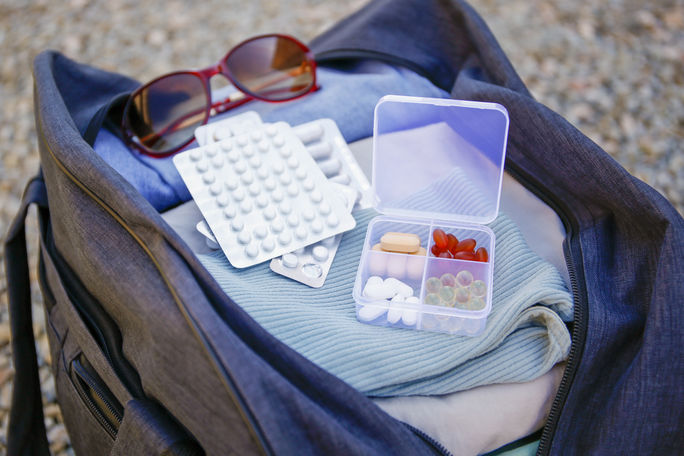
Be sure to pack your prescriptions and other medication in your carry-on bag for ready access. (Photo Credit: Adobe Stock/Viktoriia M)
Mentality
The first obstacle
may be the lingering worry that you might experience a flare-up and find
yourself unfit to travel when the departure date actually arrives, which could
deter you from making plans in the first place. What if an attack comes on
mid-trip and you find yourself without your usual means of mitigating the
symptoms? It will probably be necessary to remind yourself constantly of the
benefits you’ll enjoy because of your trip—seeing friends or loved ones, experiencing
new things or the singular enjoyment that comes from a change of scenery.
Planning Ahead
If your budget
allows, you may wish to purchase travel insurance with Cancel For Any Reason
coverage, so that you can back out of your trip in case the worst-case scenario
does occur. Be sure to look thoroughly into the terms of your policy, however,
as some may not reimburse you 100 percent of your travel expenses.
Communication
If you’re
traveling with companions, be transparent about your condition. The pressures
of traveling, particularly in a group, can be compounded if other members of
your party don’t realize that you’re in appreciable pain. With invisible
ailments, it’s essential to communicate your needs and limitations to your group
so that they are aware of and can accommodate your restrictions, or at least
understand when you need to dip out of an activity and go rest in your room.
Reduce Travel
Time
There are things
you can do to help reduce the amount of time you spend on your travel journey,
most of which involve some extra expense. You can minimize time spent standing
in security screening queues by enrolling in TSA Precheck, which allows you to use
a dedicated lane for expedited screening service. If possible, you’ll also want
to opt for a direct flight to reduce time spent in transit and lugging your
bags around multiple airports.

Bring along comfort items like a neck pillow or lumbar support for use while flying. (Photo Credit: Adobe Stock/furyon)
Pack Light
Perhaps this one
is intuitive (and it’s definitely easier said than done), but you’ll want to
pack as lightly as possible. Hauling around a heavy suitcase can easily
aggravate your chronic pain condition, and the walk between your car and the
airport or hotel room can quite suddenly seem very arduous. Of course, ensure
you’ve got a suitcase with wheels to make things easier. If possible, you could
consider shipping bulky items directly to your destination. There are companies
like Luggage Free, Send My Bag and Lugless that deliver
directly to your accommodations.
Bring Comfort
Items
Packing lightly
can sometimes prove challenging given my next tip, which is that you pack items
that keep you comfortable while both awake and asleep. If you need to stuff a
special pillow, heating or cooling pads into a larger suitcase, by all means,
do it. Perhaps you need to bring along certain food or snack items that help minimize inflammation.
CBD products can be
brought aboard airplanes as long as the THC content is no higher than 0.3
percent (and you are flying between states or countries where it’s legal).
Packing Medications
It may be helpful
to use a travel pill organizer so you don’t need to fumble through bottles
buried inside your luggage and can bring only the amount of medication you
need. If you’re on an international flight, however, you may need to bring the
original bottles or copies of your prescriptions. Be sure to fill your
prescriptions in advance of your trip and bring along an extra three days’
supply in case your flight gets delayed or canceled and you’re away from home
longer than intended. To be on the safe side, you may want to bring along a
record of your condition and a list of the medications you’re taking.
Prepare Your Carry-On
Be sure to pack
your medications, water, snacks and pain management tools in your carry-on for
easy access. In case your luggage gets mishandled, you don’t want to be caught
without these things. That includes any NSAIDS or other analgesics you might
need mid-flight or while navigating the airport. A good neck pillow and stick-on
heating/cooling pads for tight muscles can prove indispensable during a flight.
I also bring a supply of cold medications and supplements with me on every
trip, as my pain becomes quite unbearable when I’m fighting any illness.
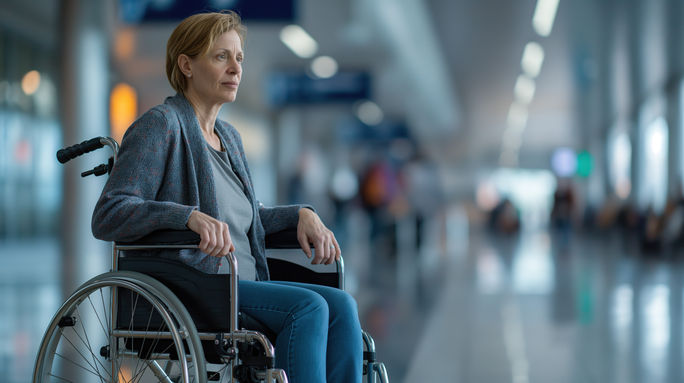
Request medical assistance or a wheelchair at the airport if it will ease your journey. (Photo Credit: Adobe Stock/Ron)
Wheelchair
Assistance
Airports are
required to provide wheelchair or medical assistance to anyone who requests
them, whether or not you typically use a wheelchair. Airlines recommend calling
at least 48 hours in advance on your departure on either end of your trip to
request a wheelchair or guided assistance, and you can also inform a gate
attendant once you arrive. This also allows you to take advantage of early
boarding, so that you don’t have to stand for extended periods of time as the
masses try to board the plane ahead of you. For more in-depth information on
these services, visit the U.S. Department of Transportation’s article on Wheelchair and Guided
Assistance.
Flying in Pain
Be sure to buy
your ticket early so you have your choice of airplane seats, and opt for as
much legroom and seat comfort as you can afford. Even if you can’t spring for
First or Business class, scoring an aisle seat in Economy has its benefits,
allowing you to stand up and stretch or move around more mid-flight. Even if
you have to squeeze past seatmates to do so, be sure to get up and move a bit
during the flight to reduce stiffness and improve circulation.
Throughout your
travel journey, you’ll want to stay hydrated and eat as well as possible to
keep your blood sugar levels stable and avoid inflammation-triggering foods
(like most of the stuff that’s typically available on the go). This is
definitely easier said than done when you’re having to dine at the airport, so
keep some healthy snacks handy in your carry-on bag.
Go by Train
If air travel
comes with too many variables for you to be reasonably comfortable getting on a
plane and flying, consider rail travel as a viable alternative. Going by train
may take longer, but it comes with considerable perks, including ample legroom
and often some stunning scenery along the way. You can also choose to book sleeper
accommodations, which afford you more privacy, allow you more space to move
around an allow you to lie down flat for maximum comfort.
Go by Car
If you’re not
going too far and will be driving to your destination, many of the above
principles still apply. Keep medications and comfort items close at hand, stay
hydrated and eat as healthily as possible, and make sure to take breaks roughly
every hour so that you can get out, stretch and move around. You’ll also want
to swap driving duties, if possible.
For the latest travel news, updates and deals, subscribe to the daily TravelPulse newsletter.
Topics From This Article to Explore


