Just when COVID-related travel concerns have been brought under control, here comes another curveball for would-be vacationers. NBC News just reported on recent scientific study, the findings of which were published last month in the journal Water Research, which confirmed that a species of flesh-eating bacteria can colonize the floating islands of seaweed and plastic pollution that often wash up on beaches.
Scientists were already aware that such massive mats of ocean waste can carry certain disease-causing bacteria, but the new research has raised fresh concerns about potential risks to humans, especially considering the record amounts of sargassum seaweeds arriving in popular vacation spots across Florida, Mexico and the Caribbean this year.
The study analyzed the genomes of several species of Vibrio bacteria found growing on the surfaces of the countless pieces of plastic garbage that get entangled with those vast floating fields of seaweed growing on the ocean’s surface, remaining adrift indefinitely before ultimately washing ashore.
The bacterial genus Vibrio, which is highly salt-tolerant and therefore at home in seawater, includes more than 100 species, about a dozen of which are known to be pathogenic (i.e., cause human illness). Such Vibrio bacteria is often transmitted by eating raw or undercooked seafood, or through contact with open wounds. The species most dangerous to humans is Vibrio vulnificus, a flesh-eating variety that can prove life-threatening.
Needless to say, the study’s discovery that plastic marine debris supports the full spectrum of pathogenic genes, that new Vibrio species seem to be represented in the samples and further risk assessment is warranted sparked public health concerns. While these flesh-eating infections are still relatively rare, marine biologist Rachel Diner told NBC that cases are likely to increase with time as a consequence of climate change.
“Vibrios like warm water conditions, so infections by Vibrios have been increasing over the past few decades and also the Vibrio concentrations themselves,” she said. “It’s pretty reasonable to expect that you’re going to see more infections in the future and more of these pathogenic species.”
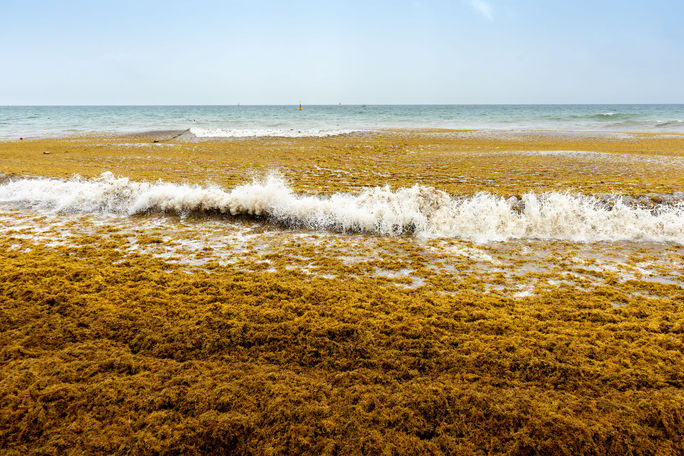
An overgrowth of sargassum choking the waters around Florida. (Image via Getty Images/carlosrojas20)
But, What About Your Beach Vacation?
So, how worried should vacationers who plan on heading for those beaches along the U.S. East Coast, the Gulf of Mexico and Caribbean coastlines being blanketed by sargassum-and-plastic swaths be? Not terribly, experts say. Yes, you might be well-advised not to go touching the sargassum mats with open wounds, and washing your hands after handling any seaweed or refuse you find washed up on the beach, but there’s no cause for panic.
“I don’t think everyone should be running away from sargassum as if it’s going to kill them,” said Linda Amaral-Zettler, a marine microbiologist at Royal Netherlands Institute for Sea Research and one of the authors of the aforementioned study. “That’s simply not the case. But I think we need to think responsibly about the potential risks.”
Of course, it’s possible that all that could change over the course of the coming decades, as the ever-compounding effects of climate change worsen and sea surface temperatures grow warmer, which would enable flesh-eating Vibrio species to flourish farther north than before.
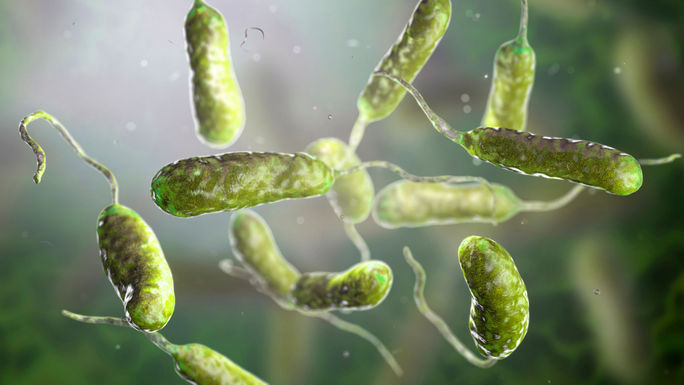
A 3D illustration of Vibrio vulnificus bacteria. (Source: iStock/Getty Images Plus/Dr_Microbe)
Then there's the Great Atlantic Sargassum Belt—which stretches across about 5,000 miles (roughly twice the breadth of the United States) from Africa’s west coast all the way up into the Gulf of Mexico—has grown exponentially larger over the past decade, to the point where the record volumes washing up on tropical shores have become entirely unmanageable.
While the most massive amounts of this troublesome brown macroalgae are predicted to arrive on North American shores from June through July, by March, NASA had already recorded the tropical Atlantic’s largest-ever bloom this year.
Besides their potential as a bacterial breeding ground, these unprecedented sargassum explosions have already taken a toll on tourism in affected area, with unsightly swaths of the stuff clogging up beaches, choking out marine wildlife and releasing hydrogen sulfide gas (with an odor reminiscent of rotten eggs) as it sits decaying on the sand.
For the latest travel news, updates and deals, be sure to subscribe to the daily TravelPulse newsletter here.
Topics From This Article to Explore


