As we stand in the starting blocks of another summer high season in Europe, now is a great time to refresh yourself with the basics of European travel, and there is nothing more fundamental to the international travel experience than the entry requirements.
The last few years have seen a steady swirl of news stories about changing entry requirements, visas and fees around the continent. Many of the stories were related to the pandemic, but they get at an oft-forgotten larger truth: things are not as simple as just hopping on a plane and showing up.
Whether you are a travel advisor with clients about to head to Europe or a traveler reading this while waiting for your ride to the airport to show up, make sure you are up to date on the following travel regulations and restrictions before you head across the Atlantic.

The national flags of various European countries scattered across a map of the region. (Adobe Stock/Maksym Yemelyanov)
Say Hello to Schengen
Before we dive into European entry requirements, we have to talk about the Schengen Area. Not already familiar with the Schengen Area? Well, now is a good time to change that because Schengen is going to come up often in this article—and be in the news often come 2025.
The basics: the Schengen Area is a travel zone encompassing 29 European countries, which essentially renders borders between them meaningless from a travel perspective. The zone was created during the 1985 Schengen Agreement and reinforced by the 1990 Schengen Convention, permanently transforming European travel.
In short, we have the Schengen Agreement and Schengen Area that it created to thank for the ability to hop on a train in Germany, wind through the Alps of Austria, and arrive in Italy without a passport check, which is a major selling point of European travel in general.
It is important to remember that while similar, the Schengen Area travel zone is entirely different from the European Union. Of the 27 EU member nations, 25 are included in the Schengen Area, with Cyprus and Ireland remaining outside the zone. For the record, Cyprus is expected to join Schengen one day, while Ireland looks set to keep its current separate entry policy for the foreseeable future.
In addition to the 25 EU nations, the four non-EU nations of Iceland, Liechtenstein, Norway and Switzerland are included in the zone, too. Micronations like Andorra, Monaco, San Marino and Vatican City are de facto members too, as they have border agreements with Spain, France and Italy.
Other notable areas not included in the Schengen Area besides Ireland and Cyprus include the United Kingdom, Turkey, Bosnia & Herzegovina, Serbia, Montenegro, North Macedonia and Albania.
Long story short: the Schengen Area is a huge travel zone that allows you to treat all 29 nations as "one country" from a passport entry perspective.

Passport and verified travel documents. (photo by Sarah Greaves-Gabbadon)
Passport Particulars
Speaking of those passports, it probably won't come as too much of a surprise to know that you're going to need a passport to be allowed into Europe. Therefore, make sure to apply for yours well before your trip, as wait times can be unpredictable.
But things aren't as simple as simply remembering to pack it and that brings us to a major European travel requirement you need to be aware of:
Your passport must have validity for the entire period you will be in Europe.
And in some cases, more. For example, if you're entering the Schengen Area, you must have the length of your trip and three additional months of validity remaining on your passport.
Yes, even if you're going to be in the Schengen Area for only two weeks (the maximum stay is 90 days), you must have three months available. So, for example, if your passport expired on December 31st, a two-week trip in October would be off the cards, even though your passport had plenty of validity left. This also means that if you're planning on being in the Schengen Zone for the full 90 days your allowed to be there, you will need to enter with six months of validity remaining on the passport.
This holds particular significance for kids under 16, given that their passports remain valid for just five years, as opposed to adults whose passports are valid for 10 years.
If you’re working with a travel advisor (and you should always work with a travel advisor!), they will likely catch any potential passport pitfalls. If you aren't, then check, re-check and triple-check your travel dates and how much validity your passport has left.
For the countries that aren't in the Schengen Area like the United Kingdom, Ireland and nations in the Balkans, you will generally just need to have validity for the duration of your stay (which varies from 90 days to six months depending on the country), although you should always check to be sure. Make note that Turkey requires six months of validity upon entry.
Soon though, you won't be able to just show up unannounced with a passport with plenty of validity on it and be admitted to the Schengen Area, and that's because of ETIAS.
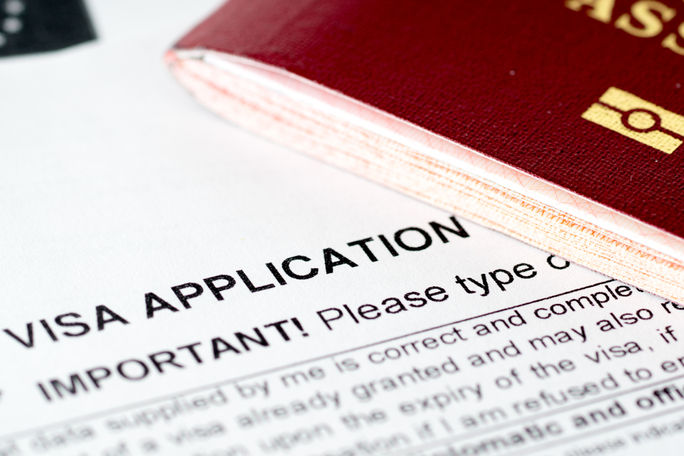
Visa application for the European Union (Photo Credit: MasterSergeant/Adobe Stock)
The State of ETIAS Affairs
It may sound like a dreamy Greek Island, but ETIAS is the name of a new requirement that Americans (and many others) will soon have to meet to visit most of Europe.
While it won't affect travelers in 2024, once it's operational, ETIAS will become a very important part of the European travel picture, so it doesn't hurt to get familiar with it now.
ETIAS stands for European Travel Information and Authorization System and it has been in the works for nearly a decade. The scheme was scheduled to roll out this year but it has once again been delayed and this time until some time in 2025. When ETIAS finally kicks in, Americans (and many others) will no longer have the luxury of relying solely on their passports for European visits and instead will need pre-approval to enter the Schengen Area plus Cyprus.
The approval will come in the form of an approved ETIAS application, a process that should unfold similarly to the ESTA process that visitors to the USA have been using for a while now, meaning it will be completed online and should only take a few minutes.
The application fee for ETIAS will be 7 Euros ($7.48) for individuals aged 18 to 70, while it will be free for other age groups and family members of EU citizens. Approved ETIAS authorizations will be valid for three years.
Like the Schengen Area, ETIAS will not be necessary to visit Ireland, the United Kingdom and many others, but you should be aware that the UK has a similar system in the works.
Again, this is not a requirement yet, but it is on its way.

A departures sign at London's Heathrow Airport. (Photo Credit: alice_photo / Adobe Stock)
Return to Sender
While this may not apply to a large swath of people, be aware that you may be required to show proof of a return flight when entering the Schengen Area or other European countries like Ireland or the United Kingdom.
If you don't have a return flight and were just planning on going with the flow, it is possible, depending on the border agent, that you may be required to show proof of financial funds that would allow you to purchase a return flight.

Bridge Rialto on Grand canal in Venice.
The Venetian Experiment
You've arrived in Europe and have plenty of validity on your passport, now you can show up anywhere and have the time of your life, right? That's true for 99.9 percent of the continent, with one major exception: Venice.
Recently, Venice became the first city in the world to impose restrictions on day-trippers, with a new five Euro (approximately $5.34) "access fee" applying on certain days in 2024.
You are exempt from the fees if you are spending the night, but you still have to download a code and carry it with you to prove that you are exempt.
Will this practice spread around the continent? Something similar is already being talked about at Lake Como, and you can rest assured that many destinations will be watching to see how things unfold in Venice.
For the latest travel news, updates and deals, subscribe to the daily TravelPulse newsletter.
Topics From This Article to Explore


