
by Mia Taylor
Last updated: 7:10 PM ET, Tue June 16, 2026
June is a special month for oceans around the world. In addition to June 8 being World Oceans Day, it’s also World Ocean Month.
And this year in particular, the need to focus on the health of the ocean is especially critical. Oceans worldwide are suffering. They're being pushed to the brink by climate change, overfishing and pollution. Coral reefs are dying and the oceans' very ability to support marine life is at risk.
In addition to all of these challenges, the Trump Administration has actively set about undermining historic ocean protections. Most recently, that has included the Trump administration’s dismantling of a $386 million ocean observatory project that over the last decade has tracked ocean circulation, marine ecosystems, climate change and extreme weather,
producing data that is freely available to the public and informing more than
500 scientific publications. The project was slated to run another 15 to
20 years, according to the Associated Press.
Earlier this year, meanwhile, the Trump Administration removed protections for endangered marine species in the Gulf of Mexico to open up the region for yet more oil drilling (The U.S. already pumps more oil than any other nation.)
The Gulf of Mexico is the Rice's whales' primary habitat and there are only about 50 of these whales still alive. The population collapsed after the 2010 Deepwater Horizon spill, an explosion that occurred on the Deepwater Horizon drilling platform in the Gulf of Mexico, causing the rig to sink and triggering a catastrophic oil leak. More oil drilling would threaten the existence of Rice whales even further.
With these types of sobering realities in mind, the United Nations is calling on every one of us to ‘reimagine’ our relationship with the ocean in 2026 in order to take part in actively helping to protect it and ensure a healthier future.
It should be obvious, but in case it isn't, the health of the oceans and the health of the planet go hand in hand. Oceans, for instance, produce at least 50% of the planet's oxygen. Moreover, oceans absorb about 30% of carbon dioxide produced by humans, buffering the impacts of global warming. Healthy oceans are also key to the world economy: An estimated 40 million people will be employed by ocean-based industries by 2030. And when it comes to the travel industry, healthy oceans worldwide are vital for tourism.
With all of these things in mind, we’ve rounded up a look at how some hotels, destinations and travel industry brands are honoring and protecting the ocean, both this month and all year long.
Outrigger Resorts & Hotels
This June, OUTRIGGER Resorts & Hotels is carrying out its largest coordinated ocean conservation effort to date, activating more than 40 marine restoration and biodiversity programs across Hawai‘i, Fiji, Thailand, Mauritius and the Maldives, while also releasing its inaugural Sustainability Report. Some of the initiatives taking place this month include:
- Planting 3,000 mangrove trees in Thailand
- Restoring 24,000 seagrass plants to support marine ecosystems and coastal resilience
- Releasing 10,000 prawns and 100 fish to help strengthen biodiversiy
- Expanding coral planting and reef restoration programs in Fiji and the Maldives
- Launching a Sculptural Coral Gene Bank with Counting Coral that will house 464 resilient coral fragments
The newly released Sustainability Report from Outrigger also highlights the company’s operational progress, including revealing that 94% of Outrigger properties now have bulk guest room amenities and there's water refill stations at every property to help reduce single-use plastic waste.
Atlantis Paradise Island, The Bahamas
In honor of World Ocean Month, Atlantis Paradise Island is highlighting some of the new milestones reached by Atlantis Blue Project Foundation (ABPF), the resort’s nonprofit 501(c)3 organization dedicated to protecting marine species and their habitats.
Over the past 20 years, ABPF has supported scientific research,
habitat restoration, and community outreach focused on coral reefs,
mangroves and marine life, according to a statement from the resort.
Combined, Atlantis and ABPF have helped rescue, rehabilitate, and
release more than 7,500 sea turtles, invested more than $5 million in
coral reef research and restoration, and contributed to the protection
of more than 1.4 million acres of marine habitat.
“Marine conservation is in our DNA and World Ocean Month is the perfect time to celebrate with our team members and guests,” Audrey Oswell, president and managing director of Atlantis Paradise Island, said in a statement.
“For decades, we’ve been actively involved in ocean research, rescue and education through the Atlantis Blue Project Foundation,” Oswell added. “Our efforts not only protect marine species and their habitats, but our work helps us inspire guests to be as passionate as we are.”
Advancing coral research and reef restoration
One year after opening, The Bahamas Coral Gene Bank at Atlantis Paradise Island remains a cornerstone of the country’s reef conservation efforts. The bio-secure facility is the first of its kind in the Bahamas and preserves coral species, supports propagation, and strengthens reef restoration in response to rising ocean temperatures and disease.
The Gene Bank has the capability to house up to 600 mature coral colonies, along with smaller fragments and juvenile corals, safeguarding the genetic diversity essential for long-term restoration. It currently protects 15 species, including Elliptical Star Coral, Pillar Coral, Maze Coral, Boulder Brain Coral, and Grooved Brain Coral.
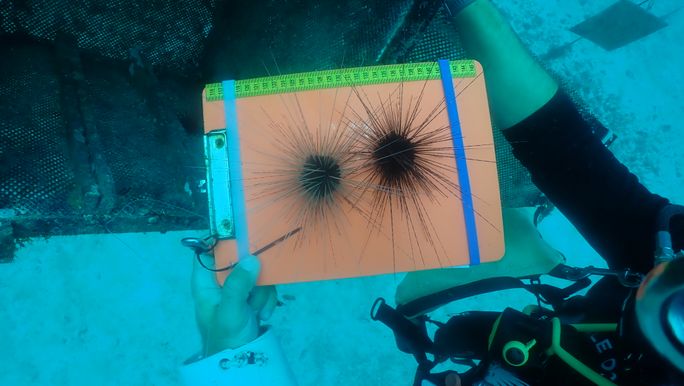
Atlantis Paradise Island has also established The Bahamas’ first Sea Urchin Nursery, (Photo Credit: Courtesy Atlantis Paradise Island)
Atlantis Paradise Island has also established The Bahamas’ first Sea Urchin Nursery, a pioneering project funded by ABPF to explore how algae-eating long-spined sea urchins (Diadema antillarum) can support coral reef recovery. Led by Jim Brittsan of Sustainable Ocean and Reefs (SOAR), the program raises juvenile urchins in a natural ocean environment designed to prepare them for successful release onto coral reefs.
Rescue, rehabilitation and release: Expanding impact
On another front, Atlantis remains the only Marine Mammal Stranding Response Facility in The Bahamas, providing critical care for stranded marine animals throughout the Americas.
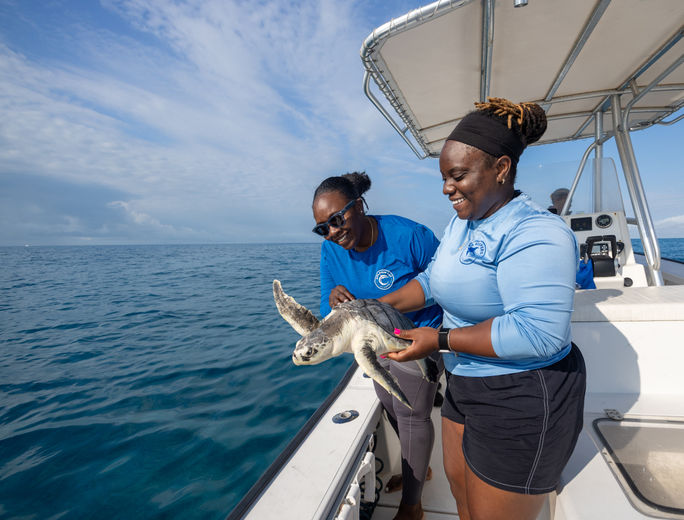
Lucky, a critically endangered Kemp’s ridley sea turtle, is released back into the ocean after rehabilitation. (Photo Credit: Courtesy Atlantis Paradise Island)
Recent facility efforts have included rehabilitating Lucky, a critically endangered Kemp’s ridley sea turtle rescued after being cold stunned in Nova Scotia and transported 2,700 miles to Atlantis for continued veterinary care.
For the past 17 years, Atlantis and ABPF have also supported the Sea Turtle Conservancy’s Tour de Turtles, a satellite-tracking initiative that advances sea turtle research and public education.
This year, Atlantis is also sponsoring an endangered adult female leatherback turtle from Soropta Beach, Panama.
Protect and preserve: Supporting critical coastal ecosystems
To help protect and preserve Bahamian wetlands, Atlantis Paradise Island propagates and grows mangroves throughout its estuaries and lagoons, supporting critical coastal ecosystems that help protect shorelines, improve water quality and provide habitat for marine life.
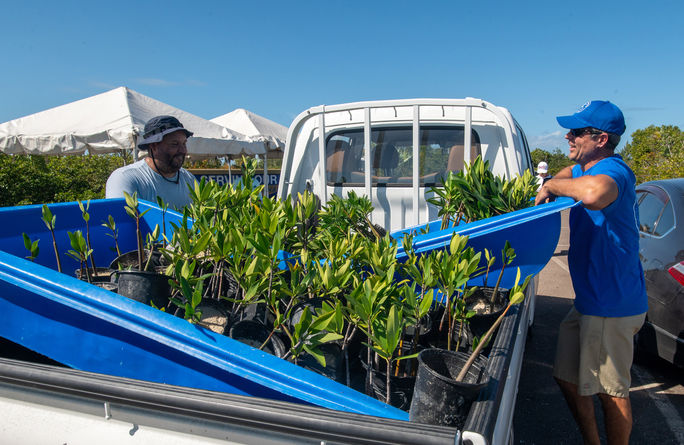
Mangrove replanting at Atlantis Paradise Island (Photo Credit: Courtesy Atlantis Paradise Island)
Since 2010, Atlantis has donated more than 8,000 young mangrove trees to nonprofit partners including The Bahamas National Trust (BNT), helping expand and restore mangrove habitats across The Bahamas while contributing to research on how mangroves can better withstand hurricane threats and strengthen coastal resilience.
Guests can see mature mangrove trees throughout the resort, including at Predator Lagoon, Estuary Lagoon and Ruins Shallows at The Royal, as well as mangrove nurseries at both Predator Lagoon and Dolphin Cay, where young propagules are nurtured into new plants.
Destin-Fort Walton Beach, Florida
A sun soaked, beachfront destination, Destin-Fort Walton Beach is home to the most active artificial reef program in the United States, with more than 580 reef sites designed to enhance marine habitats and reduce pressure on natural reefs.
The destination is also preparing to deploy the S.S. United States, which will become the world’s largest artificial reef, creating a long-term habitat for marine life and a new diving site.
Belize
Home to the second largest barrier reef in the world, the Belize Barrier Reef, the Central American country of Belize continues to expand marine protection efforts through reef restoration, mangrove conservation, and protected area management. Those efforts include expanded marine protected areas, and the Maya Forest Carbon Project, which supports long-term biodiversity protection across land and sea.
The country is also advancing sustainable tourism infrastructure through new reef protection and dive site development aimed at reducing pressure on fragile ecosystems while supporting responsible visitation.
The Bahamas
In addition to the work being done by Atlantis Paradise Island, the country of Bahamas continues working to harmonize tourism with the rigorous protection of its 100,000 square miles of ocean. Central to this mission is the Bahamas Sustainable Investment Programme, a visionary initiative aiming to raise $500 million for climate-resilient infrastructure and coastal conservation.
This program leverages the carbon-absorbing power of seagrass meadows to create Blue Carbon Credits, ensuring the destination’s most famous asset remains pristine for future generations. Beyond high-level policy, The Bahamas champions Mission for Mangroves, a dedicated effort focused on replenishing vital ecosystems through tours that engage the community and travelers in restoring shorelines essential for marine biodiversity.
For the latest travel news, updates and deals, subscribe to the daily TravelPulse newsletter.
Topics From This Article to Explore


