
by Mia Taylor
Last updated: 5:30 PM ET, Mon October 12, 2026
According to historians and scholars, there’s never been a time in human history when the world was completely free of war. While some periods have been more peaceful than others, a complete absence of conflict has never occurred.
And as of 2026, we’re experiencing the most conflicts in the history of the planet since World War II, according to a leading global security expert.
“There are 63 wars taking place around the world and 107 countries participating,” Dale Buckner, CEO of Global Guardian, a private security and crisis response company, told TravelPulse.
Wars aren’t the only factor impacting stability around the globe in 2026, Buckner added. Unrest, protests, and growing internal division are occurring in numerous countries. All of this makes it an especially fraught time to travel or make travel-planning decisions.
“You’ve got the president in Spain having a snap election. In France and India you’ve got thousands protesting over education. People are being arrested, people are getting killed. There are people with their hands blown off. It’s visceral,” continued Buckner. “And then of course the Russians just posted 100,000 soldiers on the border of Estonia. They’ve brought fuel forward to the border and they’ve brought blood to the border.”
Social issues, meanwhile, are ripping Western Europe apart. In the United States, the mid-term elections and a fractured relationship with Canada and Mexico also serve to create an uncertain backdrop for locals and travelers alike, Buckner said.
The Middle East continues to be wracked by violence thanks to Israel’s ongoing attacks on the Palestinians, which, despite widespread condemnation, are still taking place daily, according to Buckner. And not far away, the U.S. -Israel attack on Iran is further destabilizing the region.
All of these realities serve as the backdrop for Global Guardian’s just-released 2027 Global Risk Map, which highlights locations where risk has increased due to geopolitical conflict, crime and gang violence, and where it has eased amid more stable security conditions and infrastructure.
Read on to learn what the map reveals about travel in the year ahead, including destinations that have increased in risk and those that have become more stable.
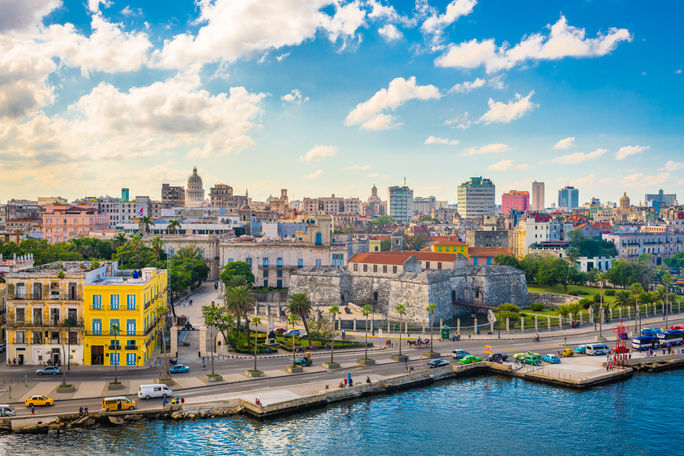
Havana, Cuba (Photo Credit: Adobe Stock)
Coutries where risk has increased
The Global Risk Map categorizes countries’ safety worldwide on a risk spectrum, from low risk to the most dangerous: extreme risk. Three categories fall between the two extremes: moderate, medium, and high. Each country’s risk rating is based on a variety of indicators, including crime, conflict, health, natural disasters, infrastructure, political stability, civil unrest, and terrorism.
While no location in the world is risk-free for travelers, the map shows that areas of ‘medium risk’ and above require more careful preparation than lower-risk locations.
The Global Guardian map shows that risks have increased for the following locations.
Cuba (Moderate → Medium Risk)
A country that was opening up to Americans under the Obama Administration, welcoming American tourists for the first time in decades, Cuba has descended into abysmal, inhumane conditions under the Trump Administration.
The map’s ranking reflects that, stating that: "Risk has increased amid the worsening conditions on the island. While the security environment has not changed, rolling countrywide blackouts, acute fuel shortages, and new sanctions on Cuba’s largest conglomerate and state oil company have pushed the power grid and healthcare system toward collapse, the 2027 global risk report says."
“From a geopolitical and military standpoint, the U.S. has cut off both China and Russia from delivering oil to Cuba. This is the primary reason Cuba is in trouble,” Buckner explained. “When that happens, inflation goes through the roof, everything gets more expensive, and you’ve cut off their source of energy. And the electrical grid is not sustainable without fuel.”
In addition, Buckner continued, the U.S. “has gone above and beyond in minimizing any kind of commerce flowing into Cuba.”
“When you add all the up, you may think this is great from geopolitical standpoint because you think you’re succeeding,” Buckner explained. “But te counter narrative is that at end of the day, it’s the people that suffer the most. The people who are on the ground. Now they don’t have power. Now tourists don’t go there. That hurts your average person.”
Buckner also predicted that the realities Cuba is currently grappling with are likely to be long-term. Meaning they will not be resolved until after the Trump Administration, when another administration may take office and engage Cuba differently.
The Middle East, broadly increased risk
Iran (High → Extreme Risk): Risk has increased amid the open-ended conflict with the U.S. and Israel. The war has compounded profound water management and economic challenges that prompted the largest protests in Iran since the 1979 Iranian Revolution. With a geopolitically less cautious and more repressive government in place, arbitrary detention risks have increased, and the prospect of a return to large-scale conflict is significant.
Jordan | Qatar | UAE (Moderate → Medium Risk): Risk has increased in these nations owing to ongoing regional tensions. During the 2026 Iran War, Iran demonstrated that it can and will strike locally hosted U.S. military and key economic sites in these countries.
Saudi Arabia: Risk has also increased dramatically in Saudi Arabia, driven by new geopolitical concerns. Iran has directly targeted Saudi Arabian oil and gas infrastructure and air bases. At the same time, Iran’s partners in Iraq have also launched drone strikes on Saudi Aramco sites. The conflict also ended the Saudi-Houthi truce and rekindled the Yemeni Civil War, opening the possibility of further Saudi intervention in Yemen and Houthi attacks deeper into Saudi Arabia.
The risk in Saudi Arabia heightened further just this week amid a barrage of missiles and drones fired by Iran-backed Houthi rebels, which included an attack on Riyadh airport, killed at least 13 people and wounded more than 300.
Global Guardian has issued a series of alerts about Saudi Arabia over the past week, advising clients to avoid the country. Buckner says individuals who absolutely must visit Saudi Arabia should consider flying into a neighboring country instead and traveling by land, avoiding Riyadh airport entirely.
“I’m stunned the United States is not engaged there because Saudi Arabia is an ally,” said Buckner. “I think this is going to much, much, much worse for Saudi Arabia, before it gets better.”
Meanwhile in the UAE, Buckner said hotel occupancy has dropped from near 82% to around 20% amid regional destabilization. Nearby Jordan, Buckner described it as “too early to reengage” for travelers. The country has been struck multiple times amid regional hostilities with Iran, and Buckner advises avoiding visiting. This same advice holds for Egypt.
“We're telling people to not go to Middle East because nobody has control over the Middle East,” Buckner said. “We would tell you to reconsider going if you’re not key essential personal. And if you have to go, be careful about what country, what city, what airport you go to. And have a true evacuation plan prior to getting on that plane.”
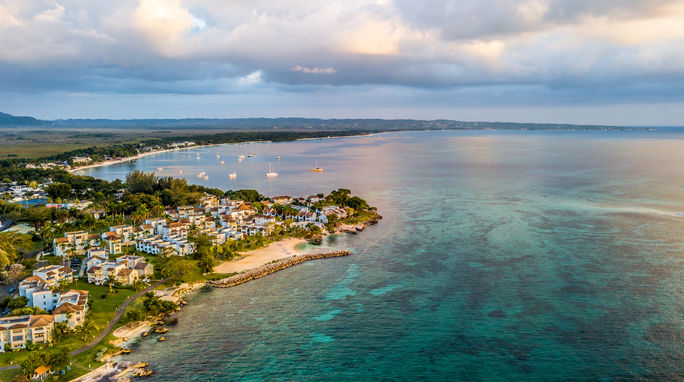
An aerial view of the beach in Negril, Jamaica (Photo Credit: Adobe Stock)
Locations that have decreased in risk
Jamaica is the year’s comeback kid. Battered by Hurricane Melissa in 2025, which left billions of dollars in damage, the Caribbean nation has worked hard to recover quickly. The Global Guardian risk map reflects this improvement, showing that the country has declined from a high risk to a medium risk.
"Risk has decreased due to effective government strategies to combat crime and gang control. Between 2024 and 2025, Jamaica’s homicide rate fell by 40%, and preliminary 2026 figures show that crime continues to decrease," says the report. "Questions remain about whether security improvements will be sustained once states of emergency are lifted and the military demobilizes from its current joint deployments with local police."
Buckner told TravelPulse that the country’s leaders have got the drug trade back under control, which has helped the country’s risk category decrease.
“If you think about Jamaica, much like the Bahamas and Haiti, the drug trade hasn’t gone away, but it’s being managed and it’s quieter,” Buckner explained. “You’ve seen a material pivot with law enforcement with Jamaica, a material focus to getting things back under control.”
A downturn in the drug trade combined with the government’s stepped-up effort to control the situation has created what Buckner describes as a more secure environment.
South Korea (Moderate → Low Risk)
Risk in South Korea has decreased following the stabilization of South Korea’s previously volatile domestic political situation. Despite the country’s deep political polarization, several factors suggest little appetite for major protest: the lack of political mobilization in response to the financial downturn, the sentencing of former President Yoon to life in prison in February 2026, and sweeping structural reforms enacted over the last year.
Hungary (Moderate → Low Risk)
The risk of civil unrest in Hungary has decreased following the ouster of Prime Minister Viktor Orban and his Fidesz Party after 16 years in power. In 2025, a combination of corruption scandals and government crackdowns on civil society drove thousands of people, as many as 200,000 at one pride protest in June 2025, to demonstrate against Fidesz leadership. Orban’s loss ends Hungary’s drift towards potentially destabilizing diplomatic isolation and removes the major driver for domestic civil unrest, reducing its risk level.
Travel tips for 2027
When considering the fraught landscape across the planet, Buckner offers some advice for individuals planning travel in the coming year.
To begin with, he stresses that simply buying travel insurance won't solve your problem if something goes wrong in conflict-affected areas.
“You want to know how these things are going to play out. And have a real ‘Get out of jail free,’ card,” he advises.
He also suggests holding off on traveling to places around the world that are actively engaged in conflict. “Don’t go to these areas where there’s a hot war. Go somewhere else and keep that location on your bucket list for another year,” says Buckner.
Finally, Buckner suggests that in many of the world’s conflict-affected regions, things are likely to get far worse before they get better. In particular, he forecasts the situation in Iran getting more violent and more aggressive after the upcoming mid-term elections in the United States. But that prediction wasn't limited to Iran. The same could be applied to Ukraine, Israel’s continued attack on Gaza and more.
“All of these things are going to get worse in 2027. It has to get worse before it gets better,” he said.
For the latest travel news, updates and deals, subscribe to the daily TravelPulse newsletter.
Topics From This Article to Explore


