
by Mia Taylor
Last updated: 7:40 PM ET, Mon September 21, 2026
Nearly one year after Hurricane Melissa devastated Jamaica and left millions of residents in dire straits, the Caribbean island is well on its way to full recovery and tourism officials have set their sights on a new future that they’ve dubbed “Jamaica 3.0.”
“We will do more than just build back; we are building back better,” Jamaica’s Minister of Tourism, Edmund Bartlett, said during the island’s recent Jamaica Product Exchange (JAPEX) conference, an annual event showcasing all that Jamaica has to offer. “We are building new and innovative experiences that are beyond sea, sand and sun…that showcase the full breadth of what our island has to offer.”
Bartlett’s speech, delivered via video conference from Dubai, capped a two-day event that is Jamaica’s premier annual travel trade and tourism gathering. Held September 14 - September 17 in Ocho Rios, Jamaica and attended by more than 400 delegates, 86 buyer companies from 19 countries and nearly 60 journalists from around the globe, the gathering was the island’s first JAPEX event since Hurricane Melissa–and the disaster was never far from mind.
The most powerful Atlantic hurricane on record and the strongest to ever hit Jamaica, Hurricane Melissa made landfall on October 28, 2025 near New Hope, Jamaica. In addition to 45 confirmed deaths, thousands were displaced by the fierce hurricane.
In his speech, Bartlett called Melissa “the guest we did not like to welcome,” describing the hurricane as “overwhelming and devastating.” He said the natural disaster impacted nearly 40 percent of the island’s GDP.
“The good news is that it's coming to the end [of our recovery efforts]...We as a people are resilient and strong. We were never defeated,” Bartlett said. “We can say to the world: 'We are small but indomitable.'”
That resilient, fierce spirit was a theme throughout JAPEX 2026, an event squarely focused on the future and the island’s plans not just to rebuild, but to offer a new, reimagined vision for Jamaican tourism and how tourism success is defined.
Recovery from Hurricane Melissa nears completion
In the immediate aftermath of Hurricane Melissa, visitation to Jamaica was halted. The damage and loss suffered by the island was a staggering $8 billion and $15 billion, or nearly a quarter of Jamaica’s gross domestic product (GDP), according to figures released by the United Nations. Moreover, Jamaica's tourism industry and agricultural production, cornerstones
of the island's economy and major sources of employment, suffered
extensive damage, putting thousands of jobs and livelihoods at risk
By mid-December 2025, however, numerous resorts and attractions resumed operating normally. And at JAPEX, Bartlett underscored that point, pointing out that Jamaica has largely rebuilt. More than 70 percent of the impacted hotel and resort stock is back in operation, Bartlett said, and remaining rooms are expected to be back online in early 2027.
“We were able to recover in a way that defies logic,” Philip Rose, Jamaica’s deputy director of tourism, said at JAPEX.
Travelers appear to have gotten the memo. About 2.3 million visitors arrived in Jamaica during the first half of 2026. In particular, luxury travel in Jamaica is booming, with villa rentals up 10 percent.
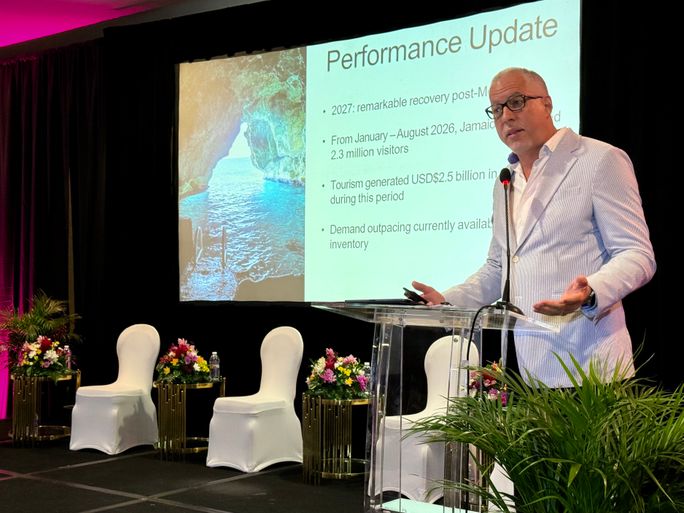
Philip Rose, Jamaica’s deputy director of tourism, speaks at JAPEX 2026 (Photo Credit: Photo by Mia Taylor)
Jamaica Reimagined: Tourism 3.0
Tourism 3.0, Jamaica Reimagined, was a major theme for JAPEX 2026. Nearly all local officials who spoke at the conference touched upon the ambitious 10-year strategic plan and the vision for how Jamaica will be presented to the world moving forward.
The new framework encompasses several pillars; key among them is an effort to move toward a tourism model for Jamaica that emphasizes local engagement and participation. Meaning moving beyond symbolic inclusion and toward measurable local economic participation. This focus also emphasizes retaining more value for stakeholders inside Jamaica, ensuring that everyone from farmers to manufacturers, artisans, transport providers and more benefits from the tourism industry.
“We have been looking at how to make our industry far more inclusive and how to secure a deeper involvement of our local people,” Bartlett explained. “And so, new policies are going to emerge.”
During a question-and-answer session with the media, Rose offered even more details about the island’s increased focus on ensuring that locals more actively benefit from tourism.
"As Jamaica enters the era of tourism 3.0, we are reimagining tourism as something that not only connects people…It must connect town and country, Kingston and the coasts…Our major resorts and our smallest communities,” said Rose.
"Tourism must be understood as an industry that belongs to every Jamaican…The farmer and the craft vendor, the restaurant worker and the entrepreneurs all contribute to tourism, and all have and will continue to benefit from it success,” Rose added.
Meaning, at its core, Jamaica 3.0 centers tourism industry growth around purpose and inclusion.
The strategic plan also calls for modernization of industry regulations in Jamaica and professionalization of the tourism industry workforce, including a new certification process for individuals employed in the travel industry. Bartlett said the goal is to increase retention of tourism industry workers, build the capacity of those same workers, improve productivity and enhance the quality of service that’s offered.
“We want to be known as a destination that offers the best service,” Bartlett explained.
“The workers in the industry…are at the heart of the new [Jamaica 3.0 travel] experience. And our effort is going to be professionalizing the industry, including training and certifying workers,” he said.
The ultimate goal of the professionalization program is to create careers for travel industry workers, moving them beyond often seasonal employees to dedicated career tracks.
Physical changes and improvements across Jamaica
Along with numerous policy efforts, Bartlett revealed several concrete plans for the island of Jamaica. Most notably, he said Montego Bay is set to be redesigned, and the “entire waterfront area will be reimagined with a special development in the Freeport area.” While he could not give a specific timeline for the project, Bartlett said design plans for Montego Bay have just been commissioned and that the area will be fully reimagined.
There are also plans for newly constructed cruise ports around the island to expand the range of experiences available to cruise visitors. (When pressed on where these cruise ports might be built and when, island officials were mum on additional details.)
Jamaica 3.0 also calls for expanded highways around the island to provide easier access from airports to the island’s various resorts.
And perhaps most surprisingly, Bartlett revealed that a casino will be coming to Jamaica, likely in the first quarter of 2027. The island's first casino license has been granted to Princes Resorts. But officials did not reveal any additional details.
When asked about the environmental impacts and ramifications of the new development plans, Bartlett said all measures will undergo stringent environmental reviews.
Jamaica prepares to embrace the future
Between the rise of AI and other new technologies, worsening fallout from climate change, constantly shifting geopolitical tensions and evolving traveler interests and desires, tourism as we all know it is changing. The way consumers discover, choose and experience a destination is also evolving.
Jamaican tourism officials get this. And their plans for Jamaica 3.0 are less about reinventing Jamaica’s offerings and more about reimagining how the island presents itself to the world, said O’Brian Heron, president of Jamaica Hotel & Tourist Association.
“The question for Jamaica is not whether change is coming, but how do we embrace innovation, while preserving the authenticity that makes Jamaica special,” said Heron during JAPEX, acknowledging that those sorts of questions will shape the future.
Still, with all the talk throughout the conference about Jamaica 3.0, tourism officials were also careful to stress that the key qualities that have always made the destination so special and one that visitors return to again and again will most certainly not be changing.
“As we speak about the future, we must always remember our greatest advantage,” Heron added. “It’s not technology. It’s not our infrastructure. It’s not our natural beauty. What truly differentiates us is our people. Whenever you talk to people who have visited Jamaica…what keeps pulling them back to Jamaica is the Jamaican people. It’s the warmth of our welcome.
People do not simply visit Jamaica, said Heron. They feel Jamaica in every single way. And no technology or tourism plan will change or replace that.
“Our responsibility is to find new ways to share these experiences with the world,” said Heron. “That is what Jamaica reimagined means. Not reinventing, but reimagining how we present Jamaica to a changing world.”
For the latest travel news, updates and deals, subscribe to the daily TravelPulse newsletter.
Topics From This Article to Explore


