Consider
the year in travel so far. Closed airspace over the Gulf. Fuel prices that
pushed international airfares up by double digits. Political instability
landing new headlines every day. Yet, in one corner of the travel world, the
forecast seems fine. That spot is reserved for luxury travel, which is having
one of its best years ever. Travelers are spending more, staying longer,
planning farther ahead and roving farther afield.
The latest
numbers suggest that, at the high end, uncertainty has not stopped global
exploration so much as changed how this top tier travels. They are paying
premium prices for comfort, privacy and convenience, while increasingly
treating travel as an experience worth the investment.
Virtuoso,
the luxury travel advisor network, expects its 2026 sales to rise 20.8 percent
over last year, with U.S. sales projected to increase 21.3 percent. Hotel sales
are up 24.5 percent, and cruise sales are up 22.4 percent. More revealing is
where that spending is concentrated: Bookings at hotels charging $1,500 or more
a night are growing 37 percent, more than twice the rate of lower-priced
properties.
The prices
themselves have moved dramatically, according to bookings through Virtuoso. The
average nightly rate at luxury hotels in the United States has risen to $1,445,
compared with $790 in 2019. Yet demand continues to grow.
That is the
first important signal about where luxury travel is headed: price alone is no
longer the dividing line. Value is.
At last week’s IMM LUX North America conference in Las Vegas, an
event that brings global suppliers together with travel media for informative
meetings,
several travel industry luminaries gave perspectives about
where the luxury travel industry is going.
“It doesn't
seem to be price sensitivity despite so much economic uncertainty,” said Julie
Earle-Levine, a media strategist who works with exclusive properties such as
Flockhill in New Zealand, Qualia Resort on Hamilton Island, and The Calile
Hotel in Brisbane. “There's a lot going on. But we see it is not a big deal.
Spending $30K a night is not a big deal. People are spending $200,000 on a
trip… that's phenomenal, right? They're doing exclusive buyouts. They want
lodges, experiences, privacy, access. They're really prepared to spend a lot
more money for these experiences that can't be replicated anywhere else. It
might be swimming with whale sharks at Ningaloo Reef in Australia. It might be
walking with indigenous guides in Tasmania. You can't do those things anywhere
else. It's almost not even about the money.”
For
affluent travelers, value increasingly means getting exactly what they want —
and avoiding what they do not. A 2026 study from Arrivia found that comfort was
the leading attribute consumers associated with luxury travel, followed by
convenience, privacy and attentive service. Travelers may spend heavily on a
particular hotel, suite, experience or flight while economizing somewhere else.
This
selective approach is broadening the luxury market. It is no longer defined
simply by the traveler who routinely books the presidential suite. Luxury can
mean a business-class flight, a private villa for a family celebration, a
Michelin-starred meal or a few days at a wellness retreat.
And
increasingly, it means all of them on the same trip.
With
exclusivity and privacy sitting front and center for most affluent travelers,
knowing the traveler and giving them an unexpected experience can go a long
way, said Christopher Evans, CEO of Collinson International, a global travel
and loyalty company and owner and operator of Priority Pass.
“It's also
about building longer-term relationships with your customers,” said Evans. “So,
you can, over time, start to really understand their behavior, what they're
looking for, and then tailor that. I think it’s the concept of unpublished
benefits, a different door.”
To that
end, Priority Pass created Priority Pass Private: a full-service airport luxury
experience tailored to high-net-worth travelers with expedited private
check-in, security, VIP terminals and discreet boarding direct to the aircraft.
Ultraluxe
travel is rising across the industry and across categories, according to those
who book travel as a career. In its recent Luxe Report, Virtuoso noted that 45
percent of respondents said they've seen an increase in "ultraluxe
travel" (defined as exclusive use, private or exceptionally high-end
experiences). The top five types of “ultraluxe” travel experiences in 2026:
All-inclusive experiences, Celebration travel, Privacy, Active / adventure
trips, Hyper-personalized experiences.
Time Away
Time is a
key factor in what the affluent traveler wants, or wants back, and wants to keep.
A recent Priority Pass-sponsored study showed time to be the factor affluent
travelers value most, regardless of age, added Evans. So his company fine-tuned
efficiencies in the airport experience to maximize time for the traveler.
“There's a
big shift in how you feel about the trip governed by how the journey starts.
So, if you can de-stress, you can make that an elevated experience as you start
your travel, and that feeling flows into the first few days of your trip. It
makes a massive difference. You start stressed and anxious; it does begin to
carry forward,” he said.
Similarly,
time or the sense of maximizing time plays out in the type of journey chosen.
Mark Rivers, CEO of Canyon Ranch, an American luxury wellness company that
operates destination resorts focused on integrative health and personal
transformation, discussed how travelers focus not only on saving time but also
on expanding the time they have through purposeful health and wellness programs.
“With
wealth comes that quest to preserve your life and to have more time. It is to
say to yourself, 'The best way that I can have more time is to be healthy, so
that means my health and my well-being are my priorities.’ If that's the case,
then you're willing to spend there for sure. This is happening in the whole
wellness travel space, and it's not just at that very top end where we just see
that rush of wealth and that limitless budget.”
Virtuoso
reports that wellness-focused hotels are outperforming the broader hotel
portfolio, with bookings up 28 percent, sales up 44 percent and average daily
rates up 23 percent.
But the
category has moved well beyond massages and fitness centers. Travelers are
booking retreats focused on sleep, metabolic health, mental health and,
increasingly, longevity programs that combine medical diagnostics with
five-star hospitality.
That points
toward a broader definition of luxury: The trip is valuable if it leaves the
traveler feeling better than when they arrived.
For U.S.
hotels and resorts, this creates a particularly rich field for innovation, from
destination wellness resorts to urban properties offering highly personalized
health and recovery programs.
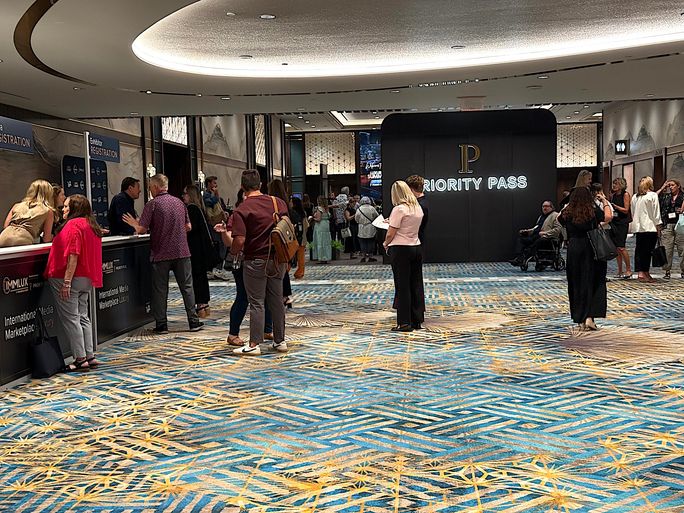
IMM LUX North America conference in Las Vegas. (Photo Credit: Lark Gould)
Flex in the
City
Meanwhile,
the old luxury itinerary template — arrive, stay in one celebrated hotel,
depart — is giving way to something more ambitious. Virtuoso calls the trend
“city-maxxing”: combining several destinations into one longer journey. Roughly
half of these itineraries cross an international border.
The
phenomenon has implications for U.S. travel suppliers. Americans who once might
have spent five nights in Paris, for example, are increasingly inclined to
build a trip around several cities, with private aviation, rail, villas or
branded residences helping make the logistics manageable.
The average
luxury stay is lengthening, and travelers are showing greater interest in
private residences as “base camps.” For hotels, that means the competition is
no longer simply another hotel. It can be a villa, residence, yacht or a highly
personalized itinerary.
For U.S.
destinations, that creates both an opportunity and a challenge. Cities and
resorts that can connect food, culture, nature, entertainment and wellness into
a seamless experience have an advantage over those selling a single attraction.
Tech Tonic
Technology
presents the industry's most interesting contradiction.
Virtuoso noted
74 percent of its advisors now use artificial intelligence. AI can make
research faster, organize information and help personalize itineraries. For
advisors, AI may make the machinery of travel more efficient while making their
trusted judgment even more valuable.
“While 70
percent of people are seeing technology improving things like security, things
like fast track, etc., travel is becoming a different experience than what it
was like yesterday, where you were challenged on how much water was in a
bottle,” said Audrey Hendley, President, American Express Travel.
“People
still want that human touch, so the ability to blend really good physical
experiences with curated and personalized digital ones and work them well
together … I think that is really the sweet spot,” said Hendley. “That human
touch, that's the service, right? It comes down to service at the end of the
day. You can have all the tools, but if you don't have the service, it all
falls short.”
Free to Do
Nothing
The
strongest theme running through the numbers is a shift away from conspicuous
luxury toward personal luxury.
Privacy.
Time. Wellness. Ease. Meaningful experiences. The ability to disconnect.
Younger
affluent travelers are part of that shift. Virtuoso bookings show millennials leading
in private-jet requests at some 6 percent above the global average, while
younger luxury travelers are also drawn to private villas, nature, cultural
experiences and wellness. At the same time, an enormous transfer of wealth is
moving assets toward younger generations, potentially expanding the luxury
travel customer base for years.
For the
U.S. travel industry, the implication is straightforward: The next generation
of luxury travelers may care less about whether a hotel is famous than about
whether it understands them. Luxury travel is not slowing down. It is becoming
more selective, more expensive and more personal.
And
increasingly, the ultimate luxury is not doing more or having more, but having
the freedom to choose exactly what matters.
For the latest travel news, updates and deals, subscribe to the daily TravelPulse newsletter.
Topics From This Article to Explore


